Info
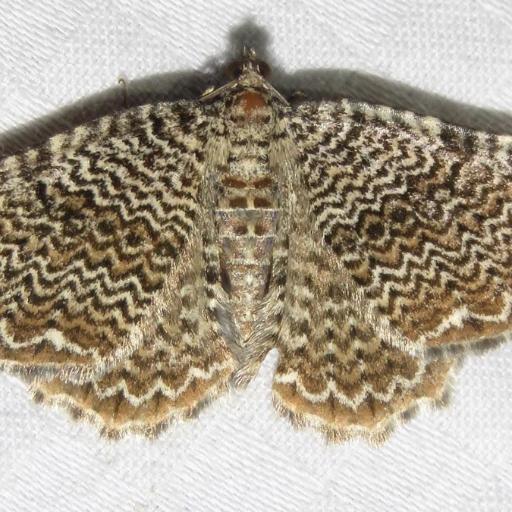
Known as the Scallop Shell moth, Rheumaptera undulata is a masterpiece of natural camouflage. Its wings are a rhythmic tapestry of fine, wavy lines that mimic the ripples of a pond or the intricate ridges of a seashell. Found across North America and Eurasia, this moth is a gentle visitor to moist woodlands and garden borders, often hiding in plain sight against the bark of trees.
🔍 How to Identify
- 🦋 Wing Pattern: The wings are covered in dozens of fine, dark, wavy lines (undulations) that run parallel across both the forewings and hindwings, creating a shimmering effect.
- 🌊 Scalloped Edges: The outer margins of the wings have a distinct zig-zag or "toothed" appearance, which is where its common name originates.
- 🛬 Resting Posture: It typically sits with its wings spread out flat against a surface, rather than folded over its back, to maximize its camouflage against textured surfaces.
🌲 Habitat & Ecology
- 🏘️ The Silk Tent: Unlike many solitary caterpillars, the larvae of the Scallop Shell moth are social architects. They spin silken webs to tie host leaves together, creating a protective "nest" or tent where they live and feed together.
- 🍽️ Diet & Host Plants: They are particularly fond of Willow (Salix), Aspen, and Wild Cherry. If you have these trees in your landscape, you are likely to see the adults fluttering near porch lights during the mid-summer months.
- 🦇 Night Life: While they are primarily nocturnal, they are easily startled from bushes during the day, flying with a quick, erratic motion to find a new hiding spot.
⚠️ Safety & Toxicity
- ✅ Harmless Neighbor: This moth is a "friend" to the gardener. It does not bite, sting, or carry any toxins that are harmful to humans.
- 🐾 Pet Safety: They are entirely safe around curious cats and dogs. The caterpillars are not known to have irritating hairs, though they should generally be left alone to complete their life cycle.
✨ Fun Fact
The Scallop Shell moth uses an "optical flicker" strategy for defense. When it rests on a textured surface, the high-contrast wavy lines break up the insect's silhouette so effectively that a bird's eye may fail to recognize it as a solid object, seeing it instead as just another shadow on the bark.
More Details








