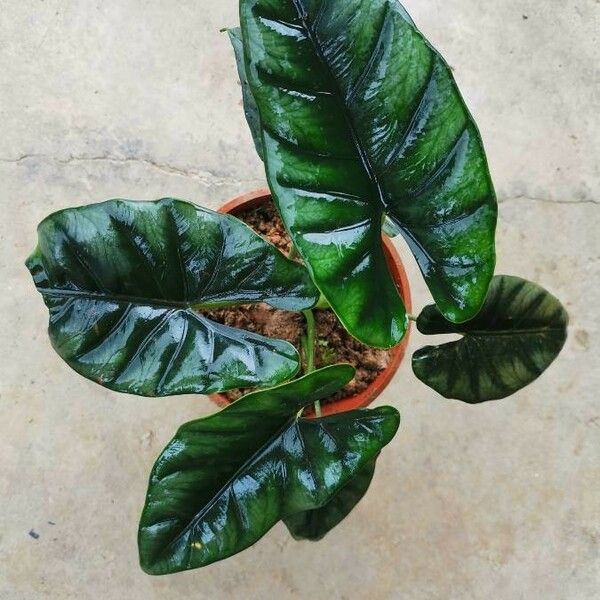
Plant Overview
Known as the "Jewel Alocasia" from the misty rainforests of Sarawak, Borneo, the Alocasia reversa is a true collector's masterpiece. Unlike most of its relatives that feature light veins on dark leaves, this plant "reverses" the aesthetic with deep, forest-green veins etched into a shimmering silver-grey blade. It is a compact, slow-growing treasure that looks more like a hand-carved piece of slate than a living organism.
🔍 How to Identify
- 🍃 Reverse Variegation: The most striking feature is the color palette—the primary and secondary veins are a dark, moody green, while the surrounding leaf surface is a pale, metallic silvery-green.
- 🛡️ Leathery Texture: The leaves are remarkably thick and stiff, possessing a matte, plastic-like finish that feels sturdy to the touch compared to the velvety texture of other Alocasias.
- 🌱 Compact Stature: As a "Jewel" variety, it remains relatively small, usually topping out around 12 inches in height, making it an ideal candidate for terrariums or shelf displays.
🏡 In Your Garden
- ☁️ The Humidity Balance: While it craves high humidity (above 60%), it is extremely sensitive to stagnant air. It requires a "breezy" environment to prevent fungal spots from marring its metallic leaves.
- 🪴 Limestone Roots: In the wild, this species often grows in rocky limestone crevices. This means it hates "wet feet" and requires an incredibly chunky, well-draining mix—think orchid bark, perlite, and charcoal rather than standard potting soil.
- 💤 Dormancy Quirks: Don't panic if it drops a few leaves in winter! If temperatures drop or light levels decrease, it may enter a semi-dormancy period where it rests before pushing out new growth in the spring.
⚠️ Safety & Toxicity
- 🚫 Status: Toxic to pets and humans.
- 🐕 Details: The plant contains calcium oxalate crystals. If chewed or ingested, it can cause intense oral irritation, swelling of the tongue and throat, and gastrointestinal upset. Always wash your hands after handling, as the sap may irritate sensitive skin.
✨ Fun Fact
The Alocasia reversa is a "lithophyte," which means it is often found growing directly on rocks rather than in soil. Because of this, it has evolved to have much more succulent-like qualities than other Alocasias, allowing it to store water more efficiently during dry spells in the jungle!

Detailed Care Instructions
To grow Alocasia Reversa plants successfully, follow these steps:
- Select a suitable location: Choose a well-lit spot for your Alocasia Reversa plant, out of direct sunlight. Indirect bright light is preferred.
- Provide the correct temperature and humidity: Keep the plant in an environment with temperatures ranging from 60-80°F (15-27°C). High humidity is essential for Alocasia Reversa plants, so consider using a humidifier or placing a tray of water next to the plant to increase humidity levels.
- Choose the right soil: Alocasia Reversa plants prefer well-draining soil that retains some moisture. Use a mixture of regular potting soil, peat moss, and perlite to ensure proper drainage.
- Planting: Select a pot that is slightly bigger than the current size of the plant's root ball. Place the plant in the pot, ensuring the top of the root ball is level with the top of the soil. Gently fill in the remaining space with soil, lightly pressing it down around the roots.
- Watering: Keep the soil consistently moist but not waterlogged. Water thoroughly when the top inch of soil feels dry. Avoid overwatering, as it can lead to root rot.
- Fertilizing: Alocasia Reversa plants benefit from regular fertilization during the growing season (spring and summer). Use a balanced, water-soluble fertilizer at half-strength every 2-4 weeks.
- Pruning: Remove any discolored or damaged leaves regularly to maintain plant health and appearance.
- Repotting: As the plant grows, you may need to repot it every 1-2 years into a slightly larger pot to accommodate its expanding root system.
- Propagation: Alocasia Reversa plants can be propagated by division, separating offsets from the mother plant during repotting. Ensure each division has its own roots and leaves.
- Pest control: Keep an eye out for common houseplant pests like aphids, mealybugs, and spider mites. If detected, treat the pests promptly using organic insecticidal soap or neem oil.
By following these guidelines, you can successfully grow an Alocasia Reversa plant and enjoy its elegant foliage.

Place in a window with dappled sun or a spot in the middle of a room. Or directly in a window facing west or east.

To properly water this plant, it is important to consider the soil moisture levels and the environment in which it is growing. The soil should be checked regularly to ensure it is moist but not waterlogged, as excessive moisture can lead to root rot. The plant should also be located in an area with indirect sunlight, as direct sunlight can cause leaf burn. When watering, it is best to use room temperature or warm water, and to allow the soil to dry out slightly between waterings. Additionally, it can be helpful to mist the plant regularly with a spray bottle to increase humidity.
To properly fertilize Alocasia Reversa, use a balanced, water-soluble fertilizer with equal amounts of nitrogen, phosphorus, and potassium.
Dilute the fertilizer in water to half the recommended strength and apply it to the soil once a month during the growing season, which is from spring to summer.
Do not fertilize the plant during the dormant period in winter.
It is important to water the plant thoroughly before and after fertilizing to prevent root burn.
Alocasia Reversa plants require a well-draining soil mixture that provides enough moisture retention while allowing air to circulate through the roots. The ideal soil for this plant should have a pH level that leans towards the acidic side, between 5.5 to 6.5. A mixture of peat moss, perlite, and coarse sand or grit is suitable for Alocasia Reversa plants. This type of soil guarantees adequate drainage while providing the right amount of aeration and moisture. It is not advisable to use regular garden soil because it may contain lumps that tend to become compacted, leading to root rot and poor growth. Similarly, clay soils that hold water are not suitable for these plants as it can lead to waterlogging and root issues. Plant owners should also avoid using heavy, dense, or water-retentive soils that can cause the plant to struggle to grow and thrive. In summary, a well-draining, loose soil mix that retains moisture, allows for aeration and has an acidic pH level is the best soil choice for Alocasia Reversa plants.
Propagation of Alocasia Reversa can be done through dividing the parent plant or through stem cuttings. To propagate through division, carefully remove the plant from its pot and separate the clumps of roots and stems. Each division should have at least one healthy stem and root system. Transplant each division into a new pot with fresh potting mix and water thoroughly.
To propagate through stem cuttings, select a healthy stem with several leaves and cut it just below a node, which is where a leaf attaches to the stem. Place the cutting in a container of water and change the water every few days. After a few weeks, the cutting should develop roots. Once the roots are several inches long, transplant the cutting into a pot with fresh potting mix and water thoroughly. Keep the newly propagated plants in a warm, humid and bright location until they establish roots and start to grow.
Common pests of the alocasia reversa include Mealybugs, spider mites, fungus gnats, aphids, thrips. Make a habit of checking your alocasia reversa frequently for pests so that any infestations can be caught and managed early.








