Plant Overview
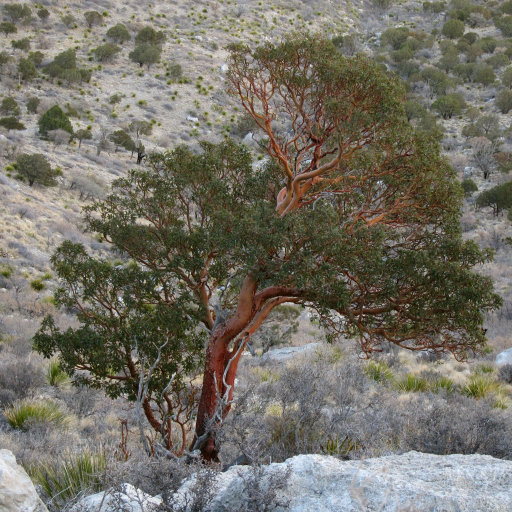
Often called the "Naked Indian Tree" or "Texas Madrone," this tree is the undisputed supermodel of the Southwestern wilderness. With its smooth, salmon-colored trunk and twisted, artistic limbs, it looks more like a living sculpture than a typical tree. It is a rare and cherished sight, often found clinging to limestone cliffs or hidden in rugged canyons from Texas down through Mexico.
🔍 How to Identify
- ✨ The Bark: Its most striking feature is the peeling, paper-thin bark that exfoliates to reveal a smooth, cool-to-the-touch inner "skin" that ranges from creamy white to deep apricot or cinnamon red.
- 🍃 The Foliage: The leaves are thick, leathery, and evergreen. They have a glossy dark-green top and a lighter underside, designed to withstand the intense sun of the Chihuahuan Desert.
- 🍓 Flowers & Fruit: In spring, it produces clusters of small, white, urn-shaped flowers. By autumn, these transform into clusters of "warty" red or orange berries that resemble tiny strawberries from a distance.
🏡 In Your Garden
- 🌱 The Transplant Diva: The Texas Madrone is notoriously difficult to grow in a nursery setting. It forms a deep taproot and relies on specific soil fungi (mycorrhizae) to survive, meaning it often suffers "failure to thrive" if moved or if its roots are disturbed.
- 🪨 High-Dry Demands: This tree demands "perfect" drainage. It thrives in rocky, alkaline, limestone-heavy soils. If you plant it in heavy clay or overwater it, the tree will likely succumb to root rot very quickly. It is a true "set it and forget it" plant once established.
⚠️ Safety & Toxicity
- ✅ Safe Status: The Texas Madrone is generally considered non-toxic to humans and animals.
- 🐾 Wildlife & Pets: The berries are a vital food source for birds (like Cedar Waxwings) and mammals. While humans can technically eat the berries—which are mildly sweet but mealy—they are not a gourmet treat. There are no known major toxicity risks for curious cats or dogs.
✨ Fun Fact
Native Americans once referred to the tree as the "Lady’s Leg" because the smooth, cool bark of the trunk feels remarkably like skin. Because the wood is incredibly dense and burns very hot, it was historically used to make high-quality charcoal for gunpowder.

Detailed Care Instructions
To grow Arbutus xalapensis, also known as Texas madrone, you can follow these steps:
- Choose the Right Location: Texas madrone prefers full sun to partial shade. Ensure that the chosen location has well-draining soil as the plant does not tolerate soggy conditions.
- Soil Preparation: Prepare the soil by adding organic matter such as compost or well-rotted manure to enhance drainage and fertility. Texas madrone thrives in slightly acidic to neutral soil with a pH range of 5.5 to 7.5.
- Planting: Plant Arbutus xalapensis in the early spring or fall when the weather is cooler. Dig a hole slightly larger and deeper than the plant's root ball. Place the plant in the hole and backfill with soil, firming it gently around the roots.
- Mulching: Apply a layer of mulch around the base of the plant, leaving a small gap around the stem to prevent moisture accumulation. Mulching helps conserve moisture, suppress weeds, and insulate the roots.
- Watering: Texas madrone is drought-tolerant, but it still requires regular watering during the first year to establish a strong root system. Water deeply, ensuring the soil is moist but not waterlogged. After the first year, the plant will be more tolerant of dry conditions.
- Pruning: Minimal pruning is required for Arbutus xalapensis. Trim away any dead, damaged, or diseased branches and lightly shape the plant if desired. Prune during the dormant season, preferably late winter or early spring.
- Fertilizing: Texas madrone does not typically require regular fertilization. However, if the soil is lacking in nutrients, you can apply a balanced organic fertilizer once a year in early spring.
- Protection: Provide protection from extreme cold temperatures, especially when the plant is young. Mulching around the base and covering with a frost cloth or burlap during freezing conditions can help safeguard the plant.
- Pests and Diseases: Arbutus xalapensis is generally resistant to pests and diseases. However, occasional issues with root rot, leaf spot, or aphids may occur. Monitor the plant regularly and treat any problems accordingly.
By following these guidelines, you can successfully grow Arbutus xalapensis and enjoy its beautiful evergreen foliage and unique red bark.

Place in a window with dappled sun or a spot in the middle of a room. Or directly in a window facing west or east.

To properly water this plant, it is important to understand its specific needs. This plant prefers moist to slightly dry soil and does not tolerate standing water or constantly wet soil. It is recommended to water deeply once a week, allowing the soil to dry slightly between waterings. When watering, aim to saturate the root zone rather than just the surface of the soil. Be sure to avoid watering the foliage as this can lead to leaf spot diseases. In the winter months, reduce watering to once every two weeks or as needed. It is important to monitor the soil moisture level and adjust watering accordingly based on environmental conditions.
For best results, fertilize this particular plant in the early spring and again in the late summer. Use a balanced fertilizer with an equal ratio of nitrogen, phosphorus, and potassium. Apply the fertilizer to the soil around the plant, being careful not to get any on the plant itself. Follow the recommended application rate on the fertilizer package, as over-fertilizing can be harmful to the plant. Water the plant thoroughly after fertilizing to help the nutrients reach the roots.
Arbutus Xalapensis plant prefers to grow in well-draining soil that is slightly acidic with a pH range of 5.5 to 6.5. The soil should be rich in organic matter and have good moisture retention capabilities while still allowing excess water to drain away. A slightly sandy-loam soil mix that contains peat moss and perlite could be used to provide the necessary conditions for healthy growth. The soil should also be loose and friable, as the plant's roots require good access to air to grow properly. It is important to avoid using heavy clay soil, as it can be too compacted and cause poor drainage, which could lead to root rot. Additionally, as the plant is native to a warm climate, it prefers well-draining soil that warms up quickly in the spring, ensuring early growth.
To propagate this plant, you can take stem cuttings during its active growth period. Choose healthy stems that are fully matured and not too woody or soft. Cut the stems at an angle with a sharp and clean knife or pair of pruning shears. Remove any leaves from the lower half of the stem. Dip the cut end of the stem into rooting hormone powder, which can help increase the chances of successful rooting. Plant the stem cuttings into a well-draining potting mix and keep it moist and in a warm, bright spot. Within a few weeks, you should see new roots forming. Once the new plant has established itself in the pot, you can transplant it into your desired location.








