Plant Overview
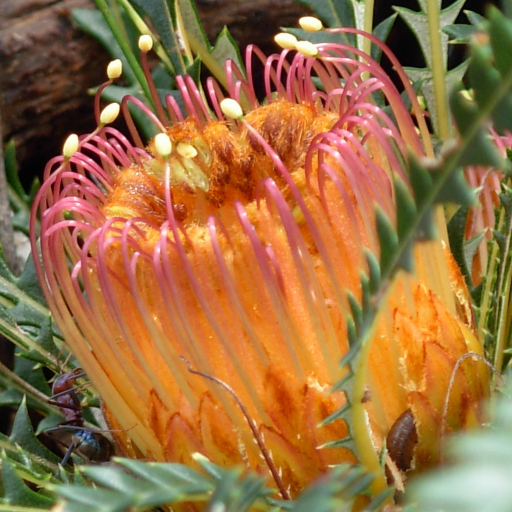
The Honeypot Banksia, scientifically known as Banksia nivea, is a low-growing wonder from the coastal heaths of Western Australia. Its species name, nivea, means "snowy," referring to the striking white woolly undersides of its leaves. Unlike its towering cousins, this Banksia keeps its treasures close to the ground, forming dense, fern-like mounds that look like they belong in a prehistoric landscape.
🔍 How to Identify
- 🌿 The "Saw-Tooth" Foliage: Long, narrow leaves that are deeply divided into sharp, triangular lobes. The tops are a rich green, while the undersides are coated in a silvery-white down.
- 🍯 Hidden Blooms: The flowers are creamy-yellow to brownish-orange, often tucked away inside the foliage near ground level rather than sitting high on branches.
- 👐 Growth Habit: It typically grows as a "prostrate" or low-mounded shrub, rarely exceeding one meter in height, making it an excellent ground-covering focal point.
🏡 In Your Garden
- 🏜️ Drainage is Non-Negotiable: Because it evolved in sandy Australian soils, this plant will suffer "wet feet" and succumb to root rot if the soil stays soggy. It thrives in raised beds or sandy slopes.
- 🧪 The Phosphorus Problem: Like most members of the Proteaceae family, the Honeypot Banksia has specialized "proteoid" roots. It is highly sensitive to phosphorus, so you must use a specific "Native" fertilizer to avoid burning the plant.
- ✂️ Pruning for Shape: While it is naturally tidy, a light tip prune after the flowering season helps maintain its dense, "cushion" look and prevents the center from becoming woody and bare.
⚠️ Safety & Toxicity
- 🟢 Non-Toxic: This plant is generally considered safe and non-toxic for humans, cats, and dogs.
- ⚔️ Physical Hazard: The leaves are extremely stiff and the triangular lobes are quite sharp. Wear gloves when pruning, and avoid planting it directly next to narrow walkways where it might scratch passing legs.
✨ Fun Fact
The Honeypot Banksia is designed to be pollinated by small mammals rather than birds! Because its flowers are hidden near the ground and smell like musky honey, it attracts nocturnal marsupials like the Honey Possum, which stick their noses deep into the blooms for a sugary snack.

Detailed Care Instructions








