Plant Overview
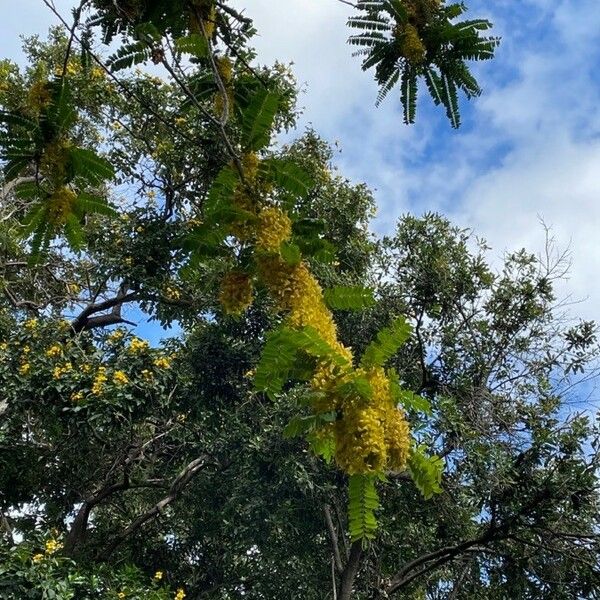
Known as the Brazilian Cassia or the "Shower of Gold," this tree is a spectacle of the Atlantic Forest. When in full bloom, the canopy appears to be dripping with liquid sunshine, as thousands of yellow flowers cascade toward the ground. It is a favorite for urban landscapers who want to add a touch of tropical grandeur to city streets and large gardens.
🔍 How to Identify
- [🌼] Golden Cascades: The most striking feature is the long, drooping clusters (racemes) of fragrant, bright yellow flowers that can reach over a foot in length.
- [🌿] Feathery Foliage: It possesses "pinnate" leaves, meaning each leaf is made up of 10 to 20 pairs of small, oblong leaflets, giving the tree a soft, airy texture.
- [🍂] Rusty Details: Its species name, ferruginea, refers to the "rust-colored" velvety fuzz that covers the young branches and flower buds.
🏡 In Your Garden
- [☀️] Sun Enthusiast: This tree is a dedicated sun-worshiper. To get that iconic "explosion" of yellow flowers, it must be planted in a spot that receives full, direct light; otherwise, it will grow leggy and sparse.
- [🌳] Space Requirements: Because it develops a wide, umbrella-shaped crown and a vigorous root system, it needs plenty of "breathing room." Avoid planting it near underground pipes or narrow walkways where its expansion might cause issues.
- [💧] Establishment Phase: While it is quite drought-tolerant once mature, young trees need consistent deep watering to help their taproots reach the water table.
⚠️ Safety & Toxicity
- [🟢] General Safety: Cassia ferruginea is generally considered non-toxic to touch and is safe for planting in high-traffic public areas.
- [🐶] Pod Precaution: Like many members of the legume family, the long seed pods contain compounds that can act as a strong laxative if eaten. Keep an eye on curious pets or toddlers who might be tempted to "snack" on the fallen brown pods.
✨ Fun Fact
[🦋] In its native Brazil, this tree is a major "pollinator hub." It is specifically designed to be visited by large bees that use "buzz pollination"—vibrating their flight muscles at a specific frequency to shake the pollen loose from the flowers!

Detailed Care Instructions
To water this type of plant, it is important to monitor the soil moisture levels regularly. The soil should always be slightly moist, but not waterlogged or completely dry. Water the plant deeply, allowing the water to saturate the soil all the way to the roots, and then allow the soil to dry out slightly before watering again. The frequency of watering will depend on factors such as the size of the pot, the temperature, and humidity levels. It is important to avoid getting water on the leaves of the plant, as this can encourage fungal growth and other diseases. Additionally, it can be beneficial to water in the morning or evening when temperatures are cooler, as this can minimize water loss due to evaporation.
Cassia ferruginea plant belongs to the Fabaceae family and requires well-draining soil that is rich in nutrients. The ideal soil for this plant is slightly acidic with a pH range of 6 to 7. It should be a mix of sandy loam and clay soil with good organic matter content.
The soil should be able to hold moisture while allowing excess water to drain out easily. A ratio of 50% soil, 20% perlite, 20% vermiculite, and 10% compost is considered ideal for Cassia ferruginea plant.
It is recommended to avoid heavy soils that do not allow adequate drainage, as this can lead to root rot and other soil-borne diseases. Similarly, soils that are too alkaline may affect the plant's growth and development.
Overall, the best soil for Cassia ferruginea plant should be well-draining, nutrient-rich, slightly acidic, and have good organic matter content.








