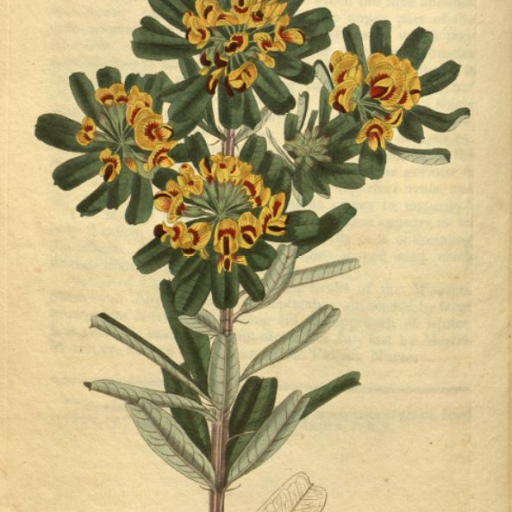
Plant Overview
Commonly known as the Heart-leaf Poison Bush, this striking evergreen shrub from Western Australia is a master of contradiction. While its vibrant, pea-like flowers and unique notched leaves make it a visual gem in the bushland, it hides a lethal secret that once devastated the livestock of early settlers. Today, it is admired for its resilience and its fascinating role in Australia’s unique evolutionary history.
🔍 How to Identify
- 🍃 The Leaf Shape: True to its name, the leaves are wedge-shaped or "bilobed," meaning they have a distinct notch at the tip that makes them look like stylized hearts.
- 🌼 Pea-Style Blooms: It produces dense clusters of bright orange and yellow flowers, often with a deep red "eye" at the center, typical of the Fabaceae family.
- 🌿 Growth Habit: This is a sturdy, multi-stemmed shrub that can reach up to 3 or 4 meters, often forming thickets with slightly hairy young branches.
🏡 In Your Garden & Ecology
- ☀️ Hardy Survivor: In its native habitat, it thrives in well-drained, sandy, or gravelly soils. It is incredibly drought-tolerant once established and prefers a sunny spot to maximize its flowering potential.
- 🔥 Fire Adaptation: Like many Australian natives, it has a complex relationship with fire; its seeds often remain dormant in the soil for years, waiting for the heat of a bushfire to trigger a massive germination event.
- 🥣 Phosphorus Sensitivity: If you are growing this or similar species, avoid standard fertilizers. They require "Native" specific blends, as high phosphorus levels can quickly overwhelm and kill the plant.
⚠️ Safety & Toxicity
- 🚫 Status: EXTREMELY TOXIC. This plant contains high concentrations of sodium fluoroacetate, a deadly metabolic poison known commercially as "1080."
- 🐾 Danger to Animals: It is highly lethal to non-native mammals, including dogs, cats, sheep, and cattle. Even a small amount of foliage can be fatal. Interestingly, many native Australian animals have evolved a natural resistance to this poison.
- 👶 Human Risk: It should never be planted in gardens accessible to children or pets. Ingestion requires immediate emergency medical intervention.
✨ Fun Fact
The Gastrolobium bilobum actually helped protect Australian wildlife! Because invasive foxes and feral cats ate native rodents that had consumed these toxic seeds, the predators were often poisoned. This created a "natural defense shield" that helped prevent the extinction of several small native marsupials in Western Australia.

Detailed Care Instructions








