Plant Overview
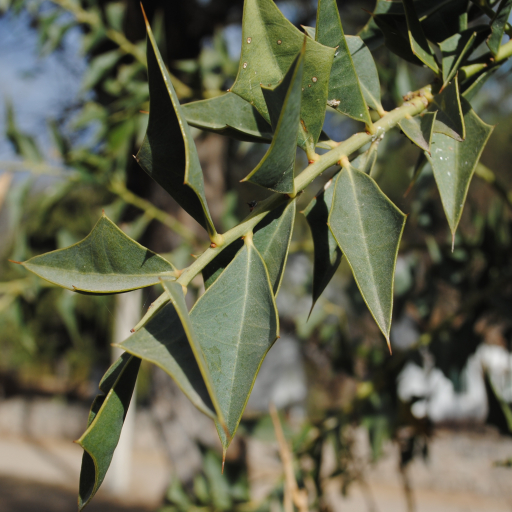
Known as the "Sombra de Toro" (Bull’s Shadow) or simply the Diamond-Leaf tree, Jodina rhombifolia is a botanical masterpiece of geometry. Native to the dry forests of South America, this slow-growing evergreen is famous for its rigid, leathery leaves that look as though they were precisely cut into diamond shapes by a craftsman. It is a rugged survivor, often found standing solitary in harsh landscapes, providing a patch of cool, dark shade for weary travelers and livestock alike.
🔍 How to Identify
- 💎 Leaf Shape: The most striking feature is the "rhomboid" leaf, which forms a perfect diamond with three sharp, yellow-tipped spines at the outer points.
- 🌿 Texture: The foliage is exceptionally thick, stiff, and leathery, with a waxy coating that helps the plant retain moisture in arid climates.
- 🌼 Flowers: In late autumn or winter, tiny, bell-shaped greenish-yellow flowers appear in clusters; they are subtle to the eye but release a powerful, honey-like fragrance.
🏡 In Your Garden
- ⏳ Growth Pace: This is a plant for the patient gardener. It grows very slowly, often taking years to transition from a shrub-like form into a small, gnarled tree, making it an excellent "living sculpture."
- ☀️ Hardiness: Because it evolved in the Gran Chaco region, it is incredibly drought-tolerant and heat-resistant. It develops a deep taproot, which means it hates being moved once planted—pick its "forever home" carefully!
- 🦋 Wildlife Value: It serves as a vital host plant for several species of South American hairstreak butterflies, providing both food for larvae and protection for adults.
⚠️ Safety & Toxicity
- 🌵 Status: Non-toxic but physically formidable.
- 🩹 Details: While the plant is not known to be poisonous to humans or pets, the spines at the tips of the leaves are needle-sharp. It should be planted away from walkways or play areas to avoid painful scratches or puncture wounds.
✨ Fun Fact
In its native regions, the wood of the Jodina rhombifolia is so dense and oil-rich that it was historically used to create long-burning, high-heat fuel, though its slow growth now makes it a protected and respected part of the ecosystem.

Detailed Care Instructions

Some plants require more regular watering than others, which should be done every few days. It's critical to maintain the soil moist all of the time. The water requirements of the same plant placed in pots with varying sizes will differ. Because the water in the smaller pot evaporates faster than the water in the larger pot, it will require more watering. Regardless of pot size, the surface should constantly be maintained moist.








