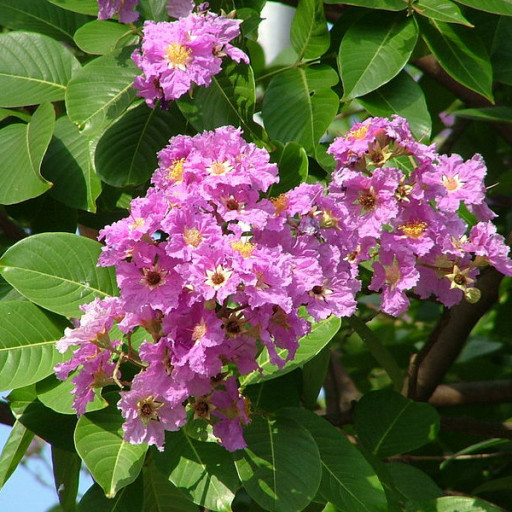
Plant Overview
Often called the "Queen’s Crape Myrtle" or the "Pride of India," this majestic tree is the grander, more regal relative of the common garden shrub. In its native Southeast Asian home, it is celebrated for its breathtaking canopy of crinkly, paper-like blossoms that shift colors throughout the day. Beyond its beauty, it holds a place of honor in traditional medicine, particularly for its "Banaba" leaves, which have been used for centuries in herbal teas.
🔍 How to Identify
- 🌸 The "Crepe" Flowers: Massive clusters of crinkled, delicate flowers that look like they are made of fine crepe paper. They typically open as a deep purple or lavender and fade to a soft pink as the sun hits them.
- 🍃 Bold Foliage: The leaves are large, leathery, and oblong—much bigger than the common Crape Myrtle. In the cooler months, they put on a brief but brilliant show, turning shades of mottled red and orange before falling.
- 🪵 Mottled Bark: The trunk is a work of art itself. It features smooth, greyish-brown bark that peels away in thin flakes to reveal a creamy, silky under-layer.
🏡 In Your Garden
- 🌳 Space is Royalty: Unlike the smaller garden varieties, the Queen's Crape Myrtle wants to be a monarch. It can reach heights of 40 to 60 feet, so it should be planted away from power lines and structures where its wide, spreading canopy can flourish.
- 💧 Drought Resilience: While it loves a good drink while establishing its roots, a mature tree is surprisingly hardy. It prefers well-drained soil and will "pout" with yellowing leaves if its roots sit in stagnant water for too long.
- ☀️ Sun Worshipper: To get that iconic explosion of purple flowers, this tree requires full, direct sun. Planting it in the shade will result in sparse leaves and very few blooms.
⚠️ Safety & Toxicity
- ✅ Safe Status: Lagerstroemia speciosa is generally considered non-toxic to humans, dogs, and cats.
- 🌱 Seed Pods: While not poisonous, the woody seed pods that follow the flowers are quite hard. They aren't a snack for pets or curious toddlers and can be a minor tripping hazard on flat walkways.
✨ Fun Fact
In the Philippines and India, the tree is known as Banaba. Its leaves contain corosolic acid, which is scientifically studied for its ability to help regulate blood sugar, earning it the nickname "Plant Insulin" in some folk-medicine circles!

Detailed Care Instructions
| Humidity | Normal |
| Lighting | Full Sun |
| Difficulty | Medium |
| Temperature | 18°C - 34°C |
| Hardiness Zones | 9 - 10 |
To successfully grow Lagerstroemia Speciosa, also known as the Queen's Crape Myrtle or Banaba, you can follow these steps:
- Choosing the right location: Lagerstroemia Speciosa requires full sun exposure for at least 6 to 8 hours a day. Select a spot in your garden or yard that receives ample sunlight.
- Soil preparation: The plant prefers well-drained soil, so ensure good drainage. Amend the soil with organic matter like compost to improve fertility and moisture retention.
- Planting: Plant Lagerstroemia Speciosa during the spring or early summer when the soil has warmed up. Dig a hole twice as wide and as deep as the root ball. Place the plant in the hole and refill with soil, gently firming it around the base of the plant.
- Watering: Newly planted crape myrtles should be watered regularly to establish their root systems. Water deeply once or twice a week during the first growing season. Afterward, they are generally drought-tolerant and can survive with less frequent watering.
- Mulching: Apply a layer of organic mulch around the base of the plant to conserve moisture and deter weed growth. Leave a small gap around the trunk to prevent rot.
- Pruning: Prune Lagerstroemia Speciosa in late winter or early spring to remove dead or crossing branches and to promote air circulation. This will help prevent disease and encourage new growth and flowering.
- Fertilizing: Feed the plant with a balanced slow-release fertilizer during the growing season, following the manufacturer's instructions. Avoid excessive fertilization, as it may lead to lush foliage but fewer flowers.
- Protection: Protect the plant from extreme weather conditions like strong winds or freezing temperatures. If necessary, cover the plant or move potted specimens indoors during winter.
- Pests and diseases: Lagerstroemia Speciosa is generally resistant to pests and diseases. However, occasionally they may face issues like aphids or powdery mildew. Monitor the plant regularly and take appropriate measures if any problems arise.
- Enjoying the blooms: With proper care, Lagerstroemia Speciosa will produce beautiful clusters of flowers, usually in shades of pink, lavender, or white, from late spring through summer. Admire their vibrant blooms and the attractive foliage they offer.
Remember, each plant's specific growth requirements can vary slightly, so it's always beneficial to observe and respond to your plant's needs.

Place in a bright room that is sun drenched almost all day. Or directly in a south-facing window.

Lagerstroemia Speciosa is a plant that requires moderate watering. One should water the plant thoroughly but avoid overwatering, as it can lead to root rot. The plant prefers well-draining soil and should be watered when the top inch of soil is dry to the touch. It is important to water the plant at the base and avoid getting water on the leaves, as this can promote fungal growth. In addition, one should avoid allowing the plant to sit in water for an extended period of time, as this can also lead to root rot. During periods of drought, the plant may require more frequent watering.
To ensure optimal growth of this plant, fertilize it with a premium quality fertilizer. The fertilizer should be rich in nutrients such as nitrogen, phosphorus, and potassium. During the growing season, apply the fertilizer once every two to three weeks. In the winter, apply the fertilizer every six weeks. Remember to water the plant well before and after fertilization. Avoid applying fertilizer when the soil is dry as this can cause root burn. Follow the recommended dosage on the fertilizer label to avoid over-fertilizing.
Lagerstroemia Speciosa is a plant that requires well-draining soil that is rich in nutrients. The soil should have a pH range of 5.0 to 6.5. The ideal soil type for this plant is a loamy soil that contains a blend of sand, silt, and clay. The loamy soil provides good drainage, good aeration and also has the ability to retain moisture. This plant prefers slightly moist soil, so it is important to avoid waterlogged soil. It is recommended to amend the soil with organic matter such as compost or aged manure to improve the fertility of the soil and promote healthy growth. Additionally, adding a slow-release fertilizer to the soil can provide essential nutrients for the plant. It is important to avoid using soil that is too heavy, too sandy or too compacted because it can hinder root growth and cause damage to the plant. Overall, the key factors for selecting soil for Lagerstroemia Speciosa are good drainage, good aeration, and high fertility.
To propagate this plant, take semi-hardwood cuttings in late summer or early autumn. Cuttings should be of a healthy and disease-free plant, around six inches long, with at least two nodes. Remove the lower leaves from the cutting and dip the end in rooting hormone. Plant the cutting in well-draining soil, deep enough to cover at least one node. Water the soil well and keep it moist but not waterlogged. Place the cutting in a bright spot with indirect sunlight and cover it with a plastic bag or a cloche to maintain humidity. Transplant the rooted cutting to a larger pot or to the ground once it has developed a good root system.








