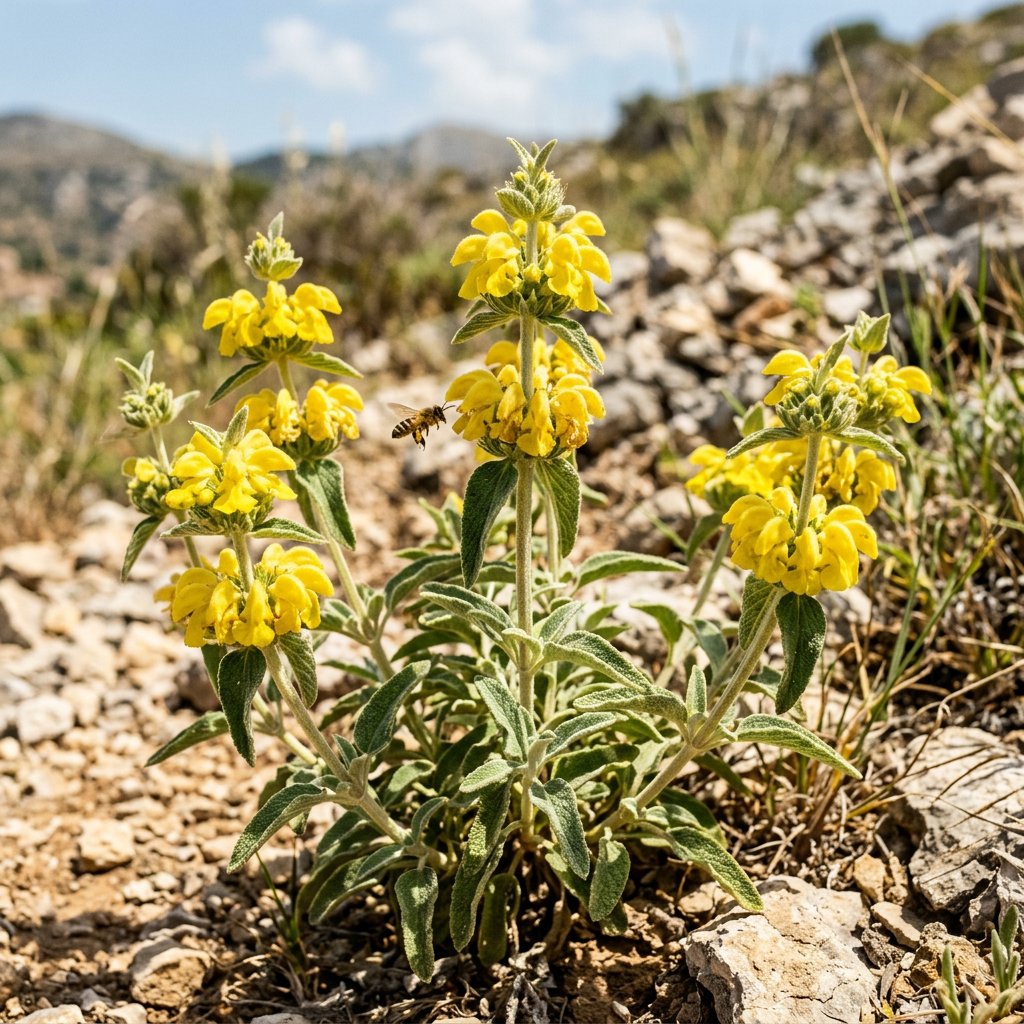
Plant Overview
Known as "Jerusalem Sage," this Mediterranean native is a visual treat that brings architectural flair to dry landscapes. Despite its common name, it isn't a true sage (Salvia) but belongs to the mint family, sharing the characteristic square stems and aromatic presence. It is a resilient "tough-love" plant that thrives where others wither, offering unique tiers of sunshine-yellow flowers that look like they were plucked from a fantasy novel.
🔍 How to Identify
- 🍃 Felted Foliage: The leaves are thick, wrinkled, and covered in a dense layer of silver-grey hairs that give the plant a soft, woolly texture.
- 🌼 Tiered Blooms: Bright yellow, hooded flowers grow in "verticillasters"—neat, circular clusters that appear to be stacked at intervals along the stems.
- 🌿 Growth Habit: It forms a dense, mounded evergreen shrub that can reach up to 4 feet in height, maintaining its silvery structure even through the winter months.
🏡 In Your Garden
- ☀️ Sun-Drenched Soul: This plant is a dedicated sun-worshipper. Its silver hairs act as a natural "sunscreen," reflecting intense heat and trapping moisture, which makes it an superstar for xeriscaping and drought-prone areas.
- 🚿 The Drainage Rule: Jerusalem Sage has a "zero-tolerance policy" for soggy roots. It requires gritty, well-draining soil; if its roots sit in water during a cold winter, the plant is likely to rot and fail to return in the spring.
- ✂️ Shape Management: Because it can become "leggy" or woody over time, it benefits from a light pruning after the first bloom. This encourages a tighter, more compact shape and often triggers a second flush of flowers.
⚠️ Safety & Toxicity
- ✅ Pet & Child Friendly: Phlomis fruticosa is generally considered non-toxic to humans, cats, and dogs, making it a worry-free addition to a busy backyard.
- 🧤 Mechanical Irritation: While not chemically toxic, the fine, star-shaped hairs on the leaves can occasionally cause mild skin irritation or "itchiness" for sensitive gardeners. Wearing gloves during heavy pruning is a smart move.
✨ Fun Fact
🕯️ The Lampwick Plant: In ancient times, the dried, felt-like leaves of this plant were so sturdy and absorbent that they were frequently rolled up and used as wicks for oil lamps.

Detailed Care Instructions
To grow Phlomis Fruticosa plants, follow these steps:
- Choose the right location: Phlomis Fruticosa plants thrive in full sun, so choose a sunny spot in your garden or yard. Ensure the location has well-draining soil.
- Prepare the soil: Enrich the soil with organic matter such as compost or well-rotted manure to improve drainage and fertility. Loosen the soil to a depth of about 6-8 inches.
- Planting: Dig a hole slightly larger than the pot's size in which the plant was originally growing. Place the Phlomis Fruticosa plant in the hole, ensuring that the top of the root ball is level with the soil surface. Fill the hole with soil, gently firming it around the roots.
- Watering: Water the plant thoroughly after planting to settle the soil. Phlomis Fruticosa plants are drought-tolerant but require regular watering until they establish a strong root system. Water deeply but less frequently to encourage deep root growth.
- Mulching: Apply a layer of mulch around the plant to conserve moisture and suppress weed growth. Organic mulch like wood chips or straw works best.
- Pruning: Prune Phlomis Fruticosa plants in late winter or early spring before new growth appears. Remove any dead or damaged branches and shape the plant as desired. This will help promote healthy growth and maintain its shape.
- Fertilizing: Phlomis Fruticosa plants do not require a lot of fertilizer. However, you can apply a balanced slow-release fertilizer in early spring, following the package instructions.
- Pests and diseases: Phlomis Fruticosa is generally resistant to pests and diseases but keep an eye out for aphids, spider mites, and powdery mildew. If necessary, treat any infestations or diseases promptly using appropriate organic pest control methods.
- Propagation: Phlomis Fruticosa can be propagated by taking softwood cuttings in late spring or semi-hardwood cuttings in summer. Dip the cuttings in rooting hormone, plant them in a well-draining potting mix, and keep them in a warm and humid environment until roots develop.
By following these steps, you can successfully grow Phlomis Fruticosa plants and enjoy their beautiful foliage and vibrant flowers.

Place in a window with dappled sun or a spot in the middle of a room. Or directly in a window facing west or east.

To properly water this plant, it is important to take into consideration its soil and environmental conditions. Phlomis fruticosa prefers well-draining soil and thrives in full sunlight.
When watering, individuals should aim to saturate the soil around the plant until water starts to drain from the bottom of the pot or container. It is essential to ensure that the soil is evenly moist since this plant is sensitive to both drought and overwatering.
During the growing season, which typically starts in the spring and lasts until fall, it is important to provide consistent moisture to encourage robust growth and development.
In the winter, individuals should reduce the frequency of watering to prevent root rot. Additionally, it is essential to monitor the plant's overall health, specifically for signs of wilting or yellowing, which can indicate either underwatering or overwatering.
To fertilize this plant, first select a balanced fertilizer that contains equal parts of nitrogen, phosphorus, and potassium. Apply the fertilizer in the early spring just as new growth begins to emerge. Use a slow-release granular fertilizer and apply it according to the package instructions. Distribute the fertilizer evenly around the base of the plant, taking care not to get it on the leaves or stems. Water the area thoroughly after fertilizing to help the nutrients soak into the soil. Repeat the application every six to eight weeks during the growing season, but do not fertilize after mid-summer as it may stimulate new growth that won't have time to harden off before winter.
The ideal soil for the plant in question is well-draining and has a pH level of neutral to slightly alkaline. The soil should also be nutrient-rich and have good organic matter content. A mix of sand, loam, and compost would be suitable. It is important to avoid heavy, clay soils that retain moisture and are prone to waterlogging, as this can lead to root rot and other problems. Additionally, adding peat moss or other acidifying amendments should be avoided, as this plant prefers a more alkaline soil environment. Overall, a well-draining, fertile soil with a pH level between 7 and 8 is best for this plant.
Propagation of this plant can be done through several methods including division, softwood cuttings, hardwood cuttings, and seed propagation. Division involves separating the plant into smaller clumps and replanting them. Softwood cuttings can be taken in the spring and rooted in a well-draining soil mix. Hardwood cuttings can be taken in the autumn and treated with rooting hormone before being placed in well-draining soil. Seed propagation involves harvesting and planting the mature seeds in the autumn. The seeds need to be stratified (exposed to cold temperatures) before planting. Regardless of the method chosen, it is important to ensure that the parent plant is healthy and disease-free.








