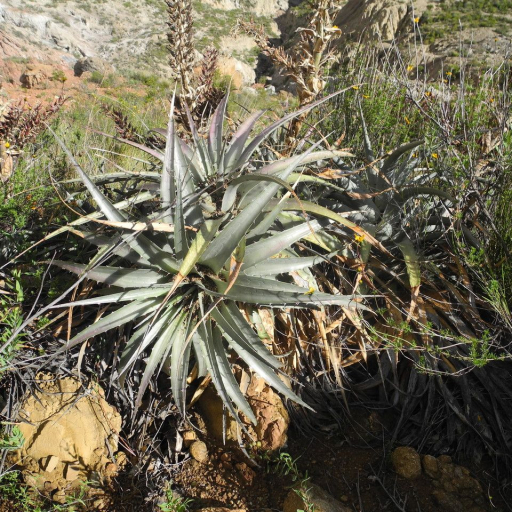
Plant Overview
Often referred to as a "Living Fossil" of the Andes, Puya meziana is a stunning terrestrial bromeliad that looks like it stepped out of a prehistoric landscape. Native to the high-altitude rocky slopes of Bolivia and Peru, this plant is prized by collectors for its architectural form and its dramatic, dark-as-night flowers. It belongs to one of the oldest lineages of the Bromeliad family, making it a rugged survivor of harsh mountain climates.
🔍 How to Identify
- ⚔️ The Foliage: A dense, symmetrical rosette of long, sword-shaped leaves that are typically silver-grey or glaucous green due to a protective waxy coating.
- 🪝 The Spines: The leaf margins are lined with sharp, recurved "teeth" or hooks that act as a natural defense against grazers.
- 🌌 The Bloom: A tall, dramatic flower spike emerges from the center, bearing bell-shaped flowers in a striking shade of deep indigo-purple or nearly black, accented by bright orange pollen.
🏡 In Your Garden
- ⛰️ Highland Heritage: Because it hails from the Andes, this plant thrives in gritty, well-draining soil and can tolerate cooler temperatures much better than its tropical cousins.
- ☀️ Light & Space: It craves bright, direct sunlight to maintain its silvery color. Give it plenty of room; its sprawling rosette and sharp edges mean it doesn't like to be crowded (and neither will you if you walk too close!).
- 💧 Drought Nuance: While it is incredibly drought-tolerant once established, it prefers occasional deep watering during the growing season to mimic mountain rain cycles.
⚠️ Safety & Toxicity
- 🟢 Chemical Safety: Puya meziana is generally considered non-toxic to humans and common household pets if accidentally ingested.
- ⚔️ Physical Hazard: The primary danger is mechanical. The sharp spines along the leaves can cause deep scratches or snag clothing easily. Wear thick gloves and eye protection when pruning or repotting.
- 👶 Placement: Keep this plant away from high-traffic pathways where children or curious pets might stumble into its "toothed" leaves.
✨ Fun Fact
Unlike many common bromeliads (like the Pineapple) which die immediately after they finish flowering, Puya meziana is a polycarpic perennial, meaning it can live for many years and potentially bloom multiple times throughout its long life!

Detailed Care Instructions
To grow Puya Meziana plants, follow these steps:
- Choose a suitable location: Puya Meziana plants typically prefer full sun to partial shade. Select a spot in your garden that receives at least 6 hours of direct sunlight per day. They also need well-draining soil.
- Prepare the soil: Puya Meziana plants prefer soil that is slightly acidic to neutral (pH 5.5-7). Ensure the soil is well-drained. You may need to amend the soil with organic matter, such as compost, to improve drainage if necessary.
- Planting: Dig a hole in the prepared soil that is slightly larger than the plant's root ball. Gently remove the plant from its container and place it in the hole. Firmly backfill the hole with soil, ensuring the plant is stable and upright.
- Watering: After planting, water the Puya Meziana thoroughly. This will help settle the soil and ensure good root-to-soil contact. Water the plant regularly, keeping the soil slightly moist. However, ensure the soil doesn't become waterlogged, as Puya Meziana plants are susceptible to root rot.
- Fertilization: Feed the plant with a balanced, slow-release fertilizer once in early spring. Follow the instructions on the fertilizer package for application rates and methods.
- Mulching: Apply a layer of organic mulch around the plant to conserve moisture, suppress weed growth, and insulate the soil. Avoid piling mulch against the stem of the plant, as it can cause rotting.
- Pruning: Prune any dead or damaged leaves from the plant to maintain its appearance and remove any potential sources of disease.
- Protection: If you live in a colder climate, you may need to protect the plant during freezing temperatures. Cover it with a frost cloth or bring it indoors during the winter if necessary.
By following these steps and providing suitable growing conditions, you can successfully grow Puya Meziana plants in your garden.
Puya Meziana is a type of plant that requires appropriate watering practices to thrive. To water the plant, you should start by creating a watering schedule based on the plant's needs. This can be determined by examining the soil to see if it is dry or moist.
When watering, it is important to avoid getting the leaves and flowers wet to prevent damage or disease. Water should be applied directly to the soil at the base of the plant. You should use a watering can or hose with a gentle spray to avoid disturbing the soil or plant roots.
The frequency of watering will depend on a variety of factors, including the weather, temperature, and humidity levels. Typically, Puya Meziana needs to be watered once or twice a week, depending on the plant's age and size. In general, it is best to water the plant deeply, allowing the water to penetrate the soil to a depth of at least 6 inches.
During the summer months or during periods of drought, you may need to water the plant more frequently to ensure adequate moisture. Conversely, during the winter months when the plant is dormant, you may need to reduce the frequency of watering to prevent overwatering and root rot.
Finally, it is important to avoid letting the plant sit in water, as this can lead to root rot. Make sure the soil has adequate drainage, and avoid leaving water in the saucer or tray beneath the pot. By following these watering practices, you can help ensure that your Puya Meziana plant remains healthy and vibrant.
To fertilize the Puya Meziana plant, use a balanced fertilizer with equal parts nitrogen, phosphorus, and potassium. Apply the fertilizer every two weeks during the growing season, which is typically from spring to fall. Avoid fertilizing during the winter months as the plant goes into a period of dormancy. Dilute the fertilizer in water according to the manufacturer's instructions and apply it directly to the soil around the base of the plant. Be sure not to over-fertilize as this can lead to root and foliage damage. Testing the soil pH and adjusting it to around 6.0 to 7.0 can also enhance the plant's ability to absorb nutrients.
Puya Meziana plant grows well in a well-draining soil type that is rich in organic matter. It is essential to avoid using heavy clay soils that can retain too much moisture, causing root rot. On the other hand, sandy soils cannot retain enough moisture to support the growth of the plant.
A recommended soil mix for Puya Meziana is a combination of coarse sand, loamy soil, and organic matter, such as peat moss or compost. The soil should have a pH level of 6.0 to 7.5 with good drainage.
It is crucial to ensure that the soil remains moist but not waterlogged, as over-watering can also lead to root rot. To maintain the soil's moisture level, it's essential to water the plant thoroughly but allow the top layer of soil to dry between watering sessions.
The plant's soil should also be well-aerated to ensure proper root development and oxygen uptake. Adding perlite or vermiculite to the soil mix can help improve aeration and drainage.
Overall, a well-draining, nutrient-rich, and aerated soil mix is essential to support the growth and health of Puya Meziana.
To propagate this plant, it is best to take offsets or pups that have grown from the mother plant. Carefully remove the pup from the mother plant ensuring that a portion of the root system is attached. Pot the pup in a well-draining soil mix and water it sparingly until it establishes its own root system. Provide the pup with plenty of sunlight and protect it from frost or extreme temperatures. It can take several years for the pup to mature enough to produce flowers.








