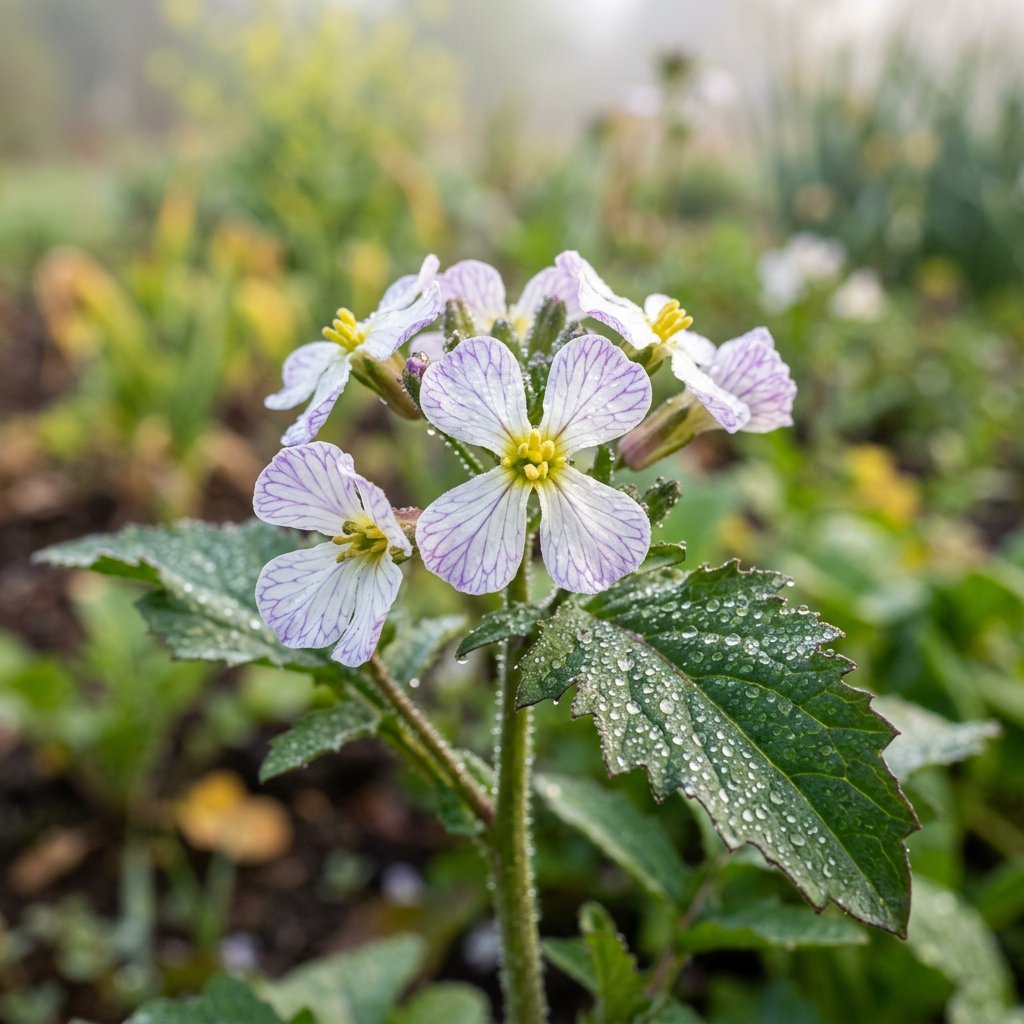
Plant Overview
The Raphanus sativus, or the humble Garden Radish, is the speed-demon of the vegetable world. Often the first sprout to pop up in a child's garden, these peppery root vegetables have been cultivated for millennia, featuring in the diets of ancient Egyptians and Romans alike. Whether they are round and ruby-red or long and icy-white, they bring a sharp, refreshing zing to any culinary dish.
🔍 How to Identify
- 🥕 The Root: While most imagine a small red sphere, roots can be cylindrical, tapered, or heart-shaped, ranging in color from deep purple and rose to stark white or even midnight black.
- 🍃 The Foliage: Leaves grow in a rosette pattern and are typically "lyrate," meaning they have a large terminal lobe and several smaller lobes along the stem, often with a slightly fuzzy or bristly texture.
- 🌸 The Bloom: If allowed to "bolt" (go to seed), the plant sends up a tall stalk with delicate, four-petaled flowers that are white, pink, or pale violet with distinct, darker veins.
🏡 In Your Garden
- 🏃 Fast-Track Growth: Radishes are prized for their rapid lifecycle; some varieties can go from seed to harvest in just 22 days. This makes them perfect "marker" plants to show where slower-growing seeds, like carrots, have been sown.
- 🪨 Soil Texture: The secret to a perfect radish is loose, stone-free soil. If the root hits a rock or compacted clay, it will become woody, overly spicy, or misshapen as it struggles to push through the earth.
- 🌡️ Temperature Sensitivity: They are cool-weather lovers. If the weather gets too hot, the plant will "bolt" (shoot up to flower), which makes the root bitter and tough.
⚠️ Safety & Toxicity
- ✅ Edible Status: Entirely safe for human consumption. In fact, the leaves and young seed pods (which taste like spicy snap peas) are also edible and highly nutritious.
- 🐾 Pet Safety: Radishes are generally non-toxic to dogs and cats. However, because of their high fiber and peppery compounds (isothiocyanates), eating large amounts may cause mild gas or digestive upset in pets.
✨ Fun Fact
In Oaxaca, Mexico, there is an annual festival every December 23rd called Noche de Rábanos (Night of the Radishes), where local artisans carve oversized, specially grown radishes into intricate sculptures of saints, animals, and historical scenes!

Detailed Care Instructions
| Color | White, Pink, Purple, Red, Yellow |
| Soil Ph | 6.0-7.0 |
| Humidity | Normal |
| Lighting | Full Sun |
| Toxicity | Non-Toxic |
| Soil Type | Loamy, Sandy, Moist, Well-Drained |
| Bloom Time | Summer |
| Difficulty | Medium |
| Plant Type | Annual |
| Hibernation | Cold Period |
| Mature Size | 2-3 Feet Tall |
| Native Area | Asia |
| Temperature | 15°C - 30°C |
| Sun Exposure | Full Sun |
| Hardiness Zones | 1-11 |
To grow Raphanus sativus, or radishes, you can follow these steps:
- Choose a suitable location: Select a sunny spot in your garden or on your balcony. Radishes prefer full sun, but they can tolerate partial shade.
- Prepare the soil: Radishes grow best in loose, well-draining soil. Remove any rocks, weeds, or debris from the planting area. If the soil is compacted, use a garden fork or tiller to loosen it.
- Amend the soil: Radishes prefer slightly acidic soil with a pH between 5.8 and 6.8. Test your soil and add compost or organic matter, such as well-rotted manure, to improve fertility and structure if needed.
- Sow the seeds: Radishes are typically grown from seeds. Follow the planting instructions on the seed packet for the recommended depth and spacing. Generally, sow the seeds about half an inch deep and one inch apart, leaving about 4-6 inches between rows.
- Water properly: Keep the soil consistently moist during the germination and growing period. Water regularly but avoid overwatering, as excessive moisture can cause the radishes to become pithy or split. Consider using a drip irrigation system or watering in the early morning to reduce the risk of fungal diseases.
- Thin the seedlings: Once the radish seedlings are about 1-2 inches tall, thin them out to provide adequate space for proper root development. Remove any crowded or weaker plants, leaving about 2-3 inches between each radish.
- Maintain moisture and manage pests: Continue to provide adequate moisture to the radishes throughout the growing season. Monitor the plants for pests, such as flea beetles or aphids, and take appropriate measures if necessary, such as using organic insecticides or introducing beneficial insects.
- Harvest the radishes: Radishes are typically ready to harvest within 3-4 weeks after sowing, depending on the variety. Pull out the radishes when they reach the desired size, usually ranging from one to three inches in diameter. Do not leave them in the ground for too long, as they can become woody and lose their crispness.
By following these steps, you should be able to successfully grow Raphanus sativus and enjoy fresh, homegrown radishes.

Place in a window with dappled sun or a spot in the middle of a room. Or directly in a window facing west or east.

To provide adequate moisture to this particular plant, it is important to maintain consistent soil moisture levels. You can do this by watering the plant deeply and thoroughly, making sure to saturate the soil around the roots. However, it is important to avoid overwatering as this can lead to waterlogging and root rot. It is also recommended to water the plant in the morning or late afternoon to avoid excessively hot temperatures. Additionally, mulching the soil can help to retain moisture and prevent water loss due to evaporation.
To fertilize this plant, begin by applying a balanced fertilizer that is high in nitrogen and phosphorus during the germination stage. During the growth stage, use a fertilizer that is higher in nitrogen content. This will support the development of the leaves and stems. Additionally, it is advisable to use a fertilizer that is rich in potassium when the plant is in its flowering stage. This will help the plant to produce larger, healthier fruits. Fertilize the soil once every two weeks, at a rate of 1-2 tablespoons per plant, or as instructed on the label.
The ideal type of soil that is suitable for growing Raphanus Sativus plants is deep, loose, and well-draining soil that is rich in organic matter. It should have a pH level between 6.0 and 7.0, which is slightly acidic to neutral.
The soil should be prepared by adding compost or manure to increase its organic matter content. It should also be free from hard, compacted, or waterlogged areas to ensure adequate oxygen supply to the plant roots.
The Raphanus Sativus plant prefers a soil that is moist but not waterlogged. Therefore, it is important to water the plant when the soil starts to feel dry to the touch. Overwatering can lead to root rot, while under-watering can cause the plant to wilt and become stunted.
In summary, to grow Raphanus Sativus plants, you need loose, well-draining, slightly acidic to neutral soil that is rich in organic matter, and has adequate moisture content.
To propagate this plant, select a healthy mature plant with strong roots and cut off a lateral shoot or side shoot. Dip the cutting in rooting hormone powder to encourage root growth, then plant it in a pot with well-draining soil. Water the cutting regularly, but avoid over-watering and keep it in a warm, humid location with indirect sunlight. After a few weeks, the cutting should start producing roots and can be transplanted into a larger pot or outdoors. Regular pruning will promote bushier growth and encourage new shoots.








