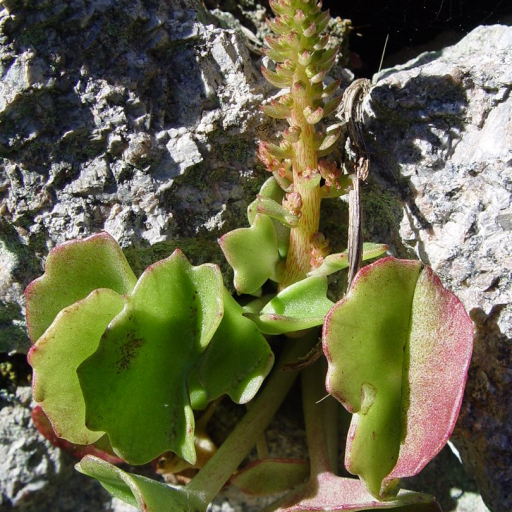
Plant Overview
Often called the "Horizontal Navelwort," this charming Mediterranean succulent looks like a collection of tiny green umbrellas or "belly buttons" scattered across rocky cliffs and ancient stone walls. It earns its name from the unique way its flowers point outward horizontally rather than drooping or standing upright. In folklore, these round, fleshy leaves were often associated with Venus, the goddess of beauty, due to their delicate and symmetrical form.
🔍 How to Identify
- 🍃 Peltate Leaves: The fleshy, succulent leaves are perfectly circular with the stem attached right in the center, creating a distinct "navel" or dimple in the middle.
- 🌸 Horizontal Blooms: The most telling feature is the flower spike; the tiny, bell-shaped blossoms grow at a 90-degree angle from the stem, distinguishing it from its vertical-flowered cousins.
- 🧱 Crevice Dweller: You will rarely find this plant in open soil. It prefers to "tuck" itself into narrow cracks in rocks, old masonry, or mossy embankments where it can hang vertically.
🏡 In Your Garden
- 🧗 The Wall Specialist: This plant is a master of vertical gardening. It thrives in rock gardens and stone walls where drainage is absolute. It "hates" wet feet and will quickly rot if planted in heavy, water-retaining garden soil.
- 💤 Summer Dormancy: Unlike many garden plants, the Navelwort often takes a "siesta" during the hottest part of the summer. It may wither or disappear entirely to survive the heat, only to magically reappear when the cooler, damp weather of autumn arrives.
⚠️ Safety & Toxicity
- ✅ Safe Status: Umbilicus horizontalis is generally considered non-toxic to humans and common household pets.
- 🐾 Mild Irritant: While not poisonous, the thick, succulent leaves are high in moisture and can cause mild digestive upset if consumed in large quantities by curious cats or dogs. It is best enjoyed as a visual ornament rather than a snack.
✨ Fun Fact
- 🏺 Ancient Signatures: In historical herbalism, this plant was part of the "Doctrine of Signatures"—a belief that a plant's shape revealed its healing properties. Because the leaf looked like a belly button, ancient healers believed it could soothe umbilical pains and intestinal issues!

Detailed Care Instructions
To grow Umbilicus horizontalis, also known as Navelwort or Pennywort, follow these steps:
- Planting: Choose a well-draining soil mix. Fill a small container or tray with the soil approximately 1/4 inch from the top. Moisten the soil slightly before planting the seeds.
- Sowing: Sprinkle the Navelwort seeds evenly across the soil surface. Gently press them into the soil, but do not cover them as they need light to germinate.
- Temperature and Light: Place the container in a warm spot with indirect sunlight or partial shade. The temperature should be around 65-75°F (18-24°C), as this plant prefers mild conditions.
- Watering: Keep the soil consistently moist but not waterlogged. Do not let the soil dry out completely. Watering once or twice a week is usually sufficient.
- Germination: Navelwort seeds usually germinate within 14-21 days. Keep an eye out for small green shoots emerging from the soil.
- Transplanting: Once the seedlings have grown a bit and have developed a few sets of true leaves, they can be transplanted to individual pots or a prepared garden bed. Space them about 6-8 inches apart.
- Maintenance: Navelwort requires regular watering to maintain consistent moisture. Mulching around the base of the plants can help retain moisture and suppress weed growth. Use organic fertilizer or compost to provide nutrients during the growing season.
- Pruning: If the plants become too leggy or overgrown, you can trim them back to encourage bushier growth. Use clean pruning shears and snip just above leaf nodes.
- Harvesting: Navelwort can be harvested once it reaches maturity, around 60-90 days from sowing. Harvest the leaves as needed, taking care not to remove more than one-third of the plant at a time.
- Propagation: Navelwort can be propagated through leaf or stem cuttings. Simply cut a healthy part of the plant and place it in moist soil, keeping it in a warm, shaded area until roots develop.
Remember to research any specific care requirements for Umbilicus horizontalis in your particular region, as growing conditions may vary.

Place in a window with dappled sun or a spot in the middle of a room. Or directly in a window facing west or east.

Umbilicus Horizontalis plant is a type of succulent plant that requires a specific watering regimen.
To water the plant, you need to first evaluate the soil moisture level. Stick your finger about an inch into the soil and see if it feels dry. If it is, then it's time to water the plant.
When watering the plant, use a watering can or hose with a gentle flow of water to avoid damaging the leaves and roots. Water the soil thoroughly and allow any excess water to drain out.
Avoid wetting the leaves and stem of the plant, as this can lead to rot and disease.
During the growing season, water the plant once a week or when the soil feels dry to the touch. In the winter months, reduce watering to once every two to three weeks to prevent overwatering.
Also, ensure that the plant is kept in a well-draining soil mix and is not left standing in water, as this can also lead to root rot.
Overall, the Umbilicus Horizontalis plant requires moderate watering and attention to soil moisture levels to thrive and grow successfully.
To fertilize the plant, mix a balanced, water-soluble fertilizer at half strength and apply it to the soil once a month during the growing season. Be careful not to over-fertilize as this can damage the roots. Additionally, it is recommended to water the plant before and after fertilizing to ensure the nutrients are evenly distributed throughout the soil.
The best soil for Umbilicus Horizontalis plant should be well-draining and loamy with a pH level between 6.0 to 7.5. It should have a moderate amount of organic matter and be rich in essential nutrients like nitrogen, phosphorus, and potassium. The soil should also provide adequate drainage and prevent water-logging to avoid root rot. Ideally, a mixture of garden soil, sand, and perlite is suitable for the healthy growth of this plant. It should be watered regularly and kept in partial shade or filtered sunlight.
Umbilicus horizontalis plant can be propagated through several methods such as division, stem cuttings, or leaf cuttings.
Division: You can divide the main plant into smaller sections and replant each new section separately. This is best done during the early spring or late fall.
Stem cuttings: Take a stem cutting from the main plant and root it in water or propagating soil. Cut the stem at a 45-degree angle and remove all but the top two leaves. Dip the end of the stem in rooting hormone powder before planting it into the propagating medium.
Leaf cuttings: You can also propagate this plant using leaf cuttings. Take a leaf from the main plant and remove the stem. Plant the leaf into a pot of propagating soil and keep it moist until it roots and forms a new plant.
Ensure that the new plants are given proper care including enough water, sunlight and nutrients.








