Info
Known as the Walnut Blister Mite, these microscopic arachnids are the hidden architects behind the strange, bubbly protrusions often found on walnut leaves. While the distorted leaves might look like a scary disease or a fungal infection, they are actually the result of a fascinating "contract" between the mite and the tree. They are harmless to humans but can turn a smooth green canopy into a bumpy, textured landscape.
🔍 How to Identify
- 🟢 The Blisters: Large, convex, green or yellowish swellings on the upper surface of the leaf that look like raised "bubbles."
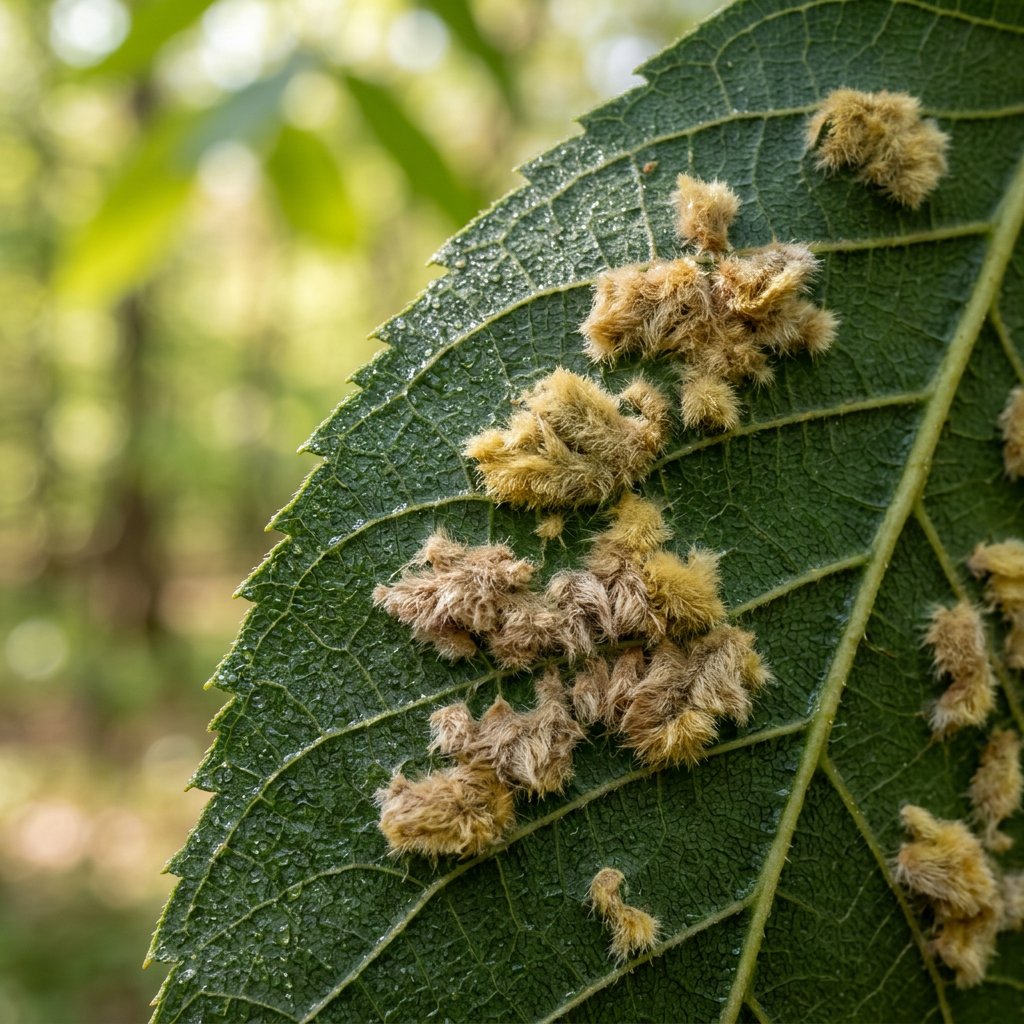
- ☁️ The Erineum: On the underside of the leaf, directly beneath each blister, you will find a fuzzy, felt-like patch that starts creamy white and turns rusty brown as the season progresses.
- 🔍 The Invisible Resident: You cannot see the mite itself without a microscope; they are tiny, elongated, worm-like creatures that live and feed deep within the fuzzy "forest" of the erineum.
🌲 Habitat & Ecology
- 🌳 The Perfect Host: These mites are highly specialized specialists; you will almost exclusively find them on English (Persian) Walnut trees (Juglans regia).
- 🏠 Life Cycle: They spend the winter hiding inside the tree's leaf buds. As soon as the leaves begin to unfurl in the spring, the mites start feeding, which triggers the leaf to grow the "blister" home for them.
- 🍃 Impact on the Tree: While the damage can look dramatic and alarming to gardeners, it is almost entirely cosmetic. The tree continues to photosynthesize, and the nut crop is usually unaffected.
⚠️ Safety & Toxicity
- ✅ Status: Harmless.
- 🐾 Details: The Walnut Blister Mite does not bite or sting humans or pets. They are not toxic, and because they are host-specific, they won't spread to your other garden plants or houseplants. There is rarely a need for chemical intervention, as nature usually sends predatory mites to keep their numbers in check.
✨ Fun Fact
The "fuzz" inside the leaf blister isn't actually part of the mite. The mite injects a chemical that "reprograms" the leaf's own cells, forcing the tree to grow a dense forest of tiny hairs to provide the mite with a perfectly humid, temperature-controlled nursery!
More Details








