Info
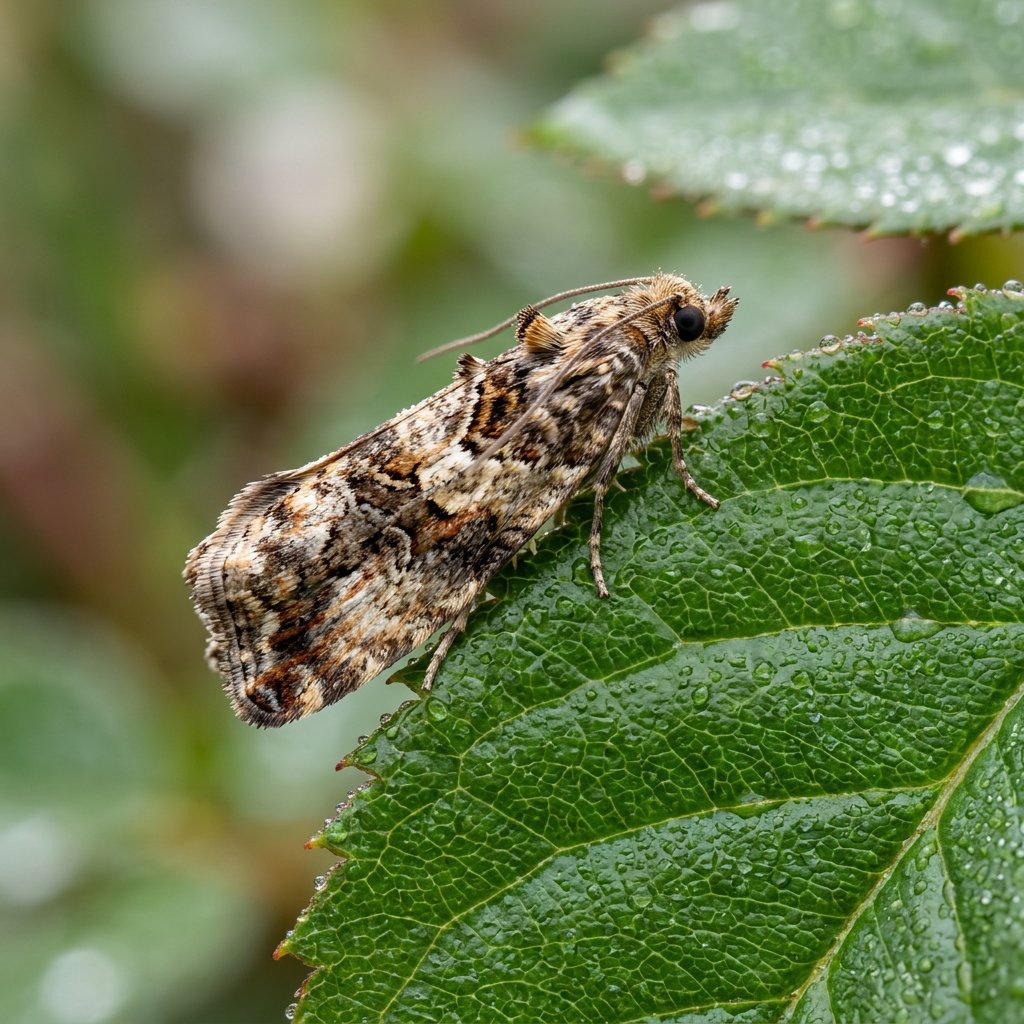
Known as the Garden Rose Tortrix, this little moth is a master of camouflage that uses a clever trick to stay safe: it mimics bird droppings. Often found tucked away in rose bushes or orchards, its wings look as if they were painted in two completely different halves, helping it disappear against the variegated light of a garden leaf.
🔍 How to Identify
- 🦋 The "Split" Pattern: The most striking feature is the forewings, which are usually divided sharply into a bright white or cream inner half and a dark, mottled brown or grey outer half.
- 📐 Bell-Shaped Silhouette: When at rest, it holds its wings in a flat, bell-like shape, a classic giveaway for members of the Tortrix family.
- 🧶 Textured Wings: Look closely and you will see tiny raised tufts of scales on the wing surface, giving the moth a rough, 3D appearance rather than a smooth, flat one.
🌲 Habitat & Ecology
- 🌹 The Leaf-Roller: As a caterpillar, this species is a "leaf-roller." It spins fine silk to fold or "roll" a leaf of a rose or fruit tree into a protective tube, where it hides from birds while it feeds.
- 🍎 Diverse Diet: While it loves roses, it is a frequent guest on Hawthorn, Apple, and Blackthorn trees. It is highly adaptable and thrives in suburban gardens, hedgerows, and woodland edges across Europe and North America.
⚠️ Safety & Toxicity
- ✅ Harmless Visitor: The Garden Rose Tortrix is completely safe for humans and pets. It does not bite, sting, or possess any irritating hairs.
- 🌿 Minor Pest: While the larvae may cause some "shotholes" or rolled leaves in your garden, they rarely cause significant damage to the plant's overall health. They are generally considered a neutral part of the garden's biodiversity.
✨ Fun Fact
🎨 A Literal Variable: Its scientific name, variegana, refers to its incredible "polymorphism." This moth is so variable in its coloring that two individuals can look like entirely different species, ranging from almost pure white to nearly solid dark brown!
More Details








