Info
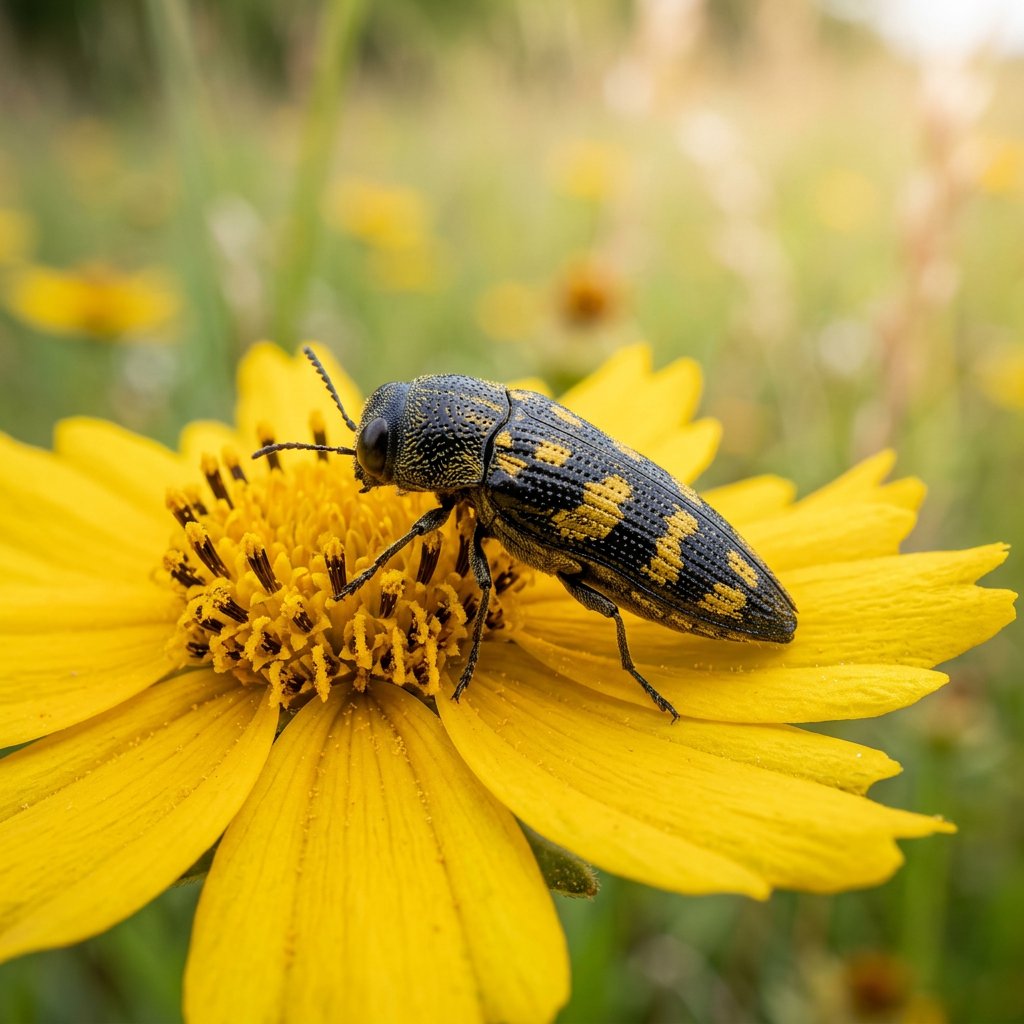
Often called the Tube-shaped Jewel Beetle, this tiny, shimmering resident is a common sight in North American woodlands and gardens. While many of its cousins are known for being destructive pests, this species is largely considered a "neutral friend"—a delicate pollinator that spends its days lounging on bright yellow flowers like a living piece of jewelry.
🔍 How to Identify
- 🪲 Body Shape: It features a distinct, cylindrical "tube-like" body that is much more narrow and elongated than typical ladybugs or leaf beetles.
- 🎨 Coloration: Its base color is a dark, metallic bronze or black, speckled with small, irregular creamy-yellow or orange spots along its back (elytra).
- 🔍 Texture: If you look closely or use a hand lens, you’ll notice the entire body is covered in fine, upright white hairs, giving it a slightly "fuzzy" appearance for a beetle.
🌲 Habitat & Ecology
- 🌼 The Flower Connection: Adults are most active in late spring and early summer. You’ll find them clinging to the centers of daisies, dandelions, or crane's-bill, where they feed on pollen and nectar.
- 🌳 The Wood Connection: While the adults love flowers, the larvae are "flatheaded borers." They develop inside the dead or dying wood of deciduous trees like Oak, Hickory, and Redbud, helping to break down old timber in the forest ecosystem.
- ☀️ Sun Lovers: These beetles are highly sun-dependent; they are most active on hot, bright days and will often hide or become sluggish when the clouds move in.
⚠️ Safety & Toxicity
- ✅ Status: Completely harmless. They do not sting, and their mandibles are far too small to bite human skin.
- 🐾 Pets & Kids: They are non-toxic. If a curious dog or cat happens to snack on one, there is no cause for alarm, though the hard shell might be a bit crunchy!
- 🏡 Home Safety: They do not infest structural timber or furniture. If one hitches a ride inside on a bouquet of flowers, simply usher it back to a sunny window or door.
✨ Fun Fact
Unlike many other beetles that take off instantly, the Acmaeodera tubulus is a bit of a "clumsy" flier. When startled, it often tucks its legs and drops straight to the ground to disappear into the leaf litter—a defensive move called thanatosis or "playing dead."
More Details








