Info
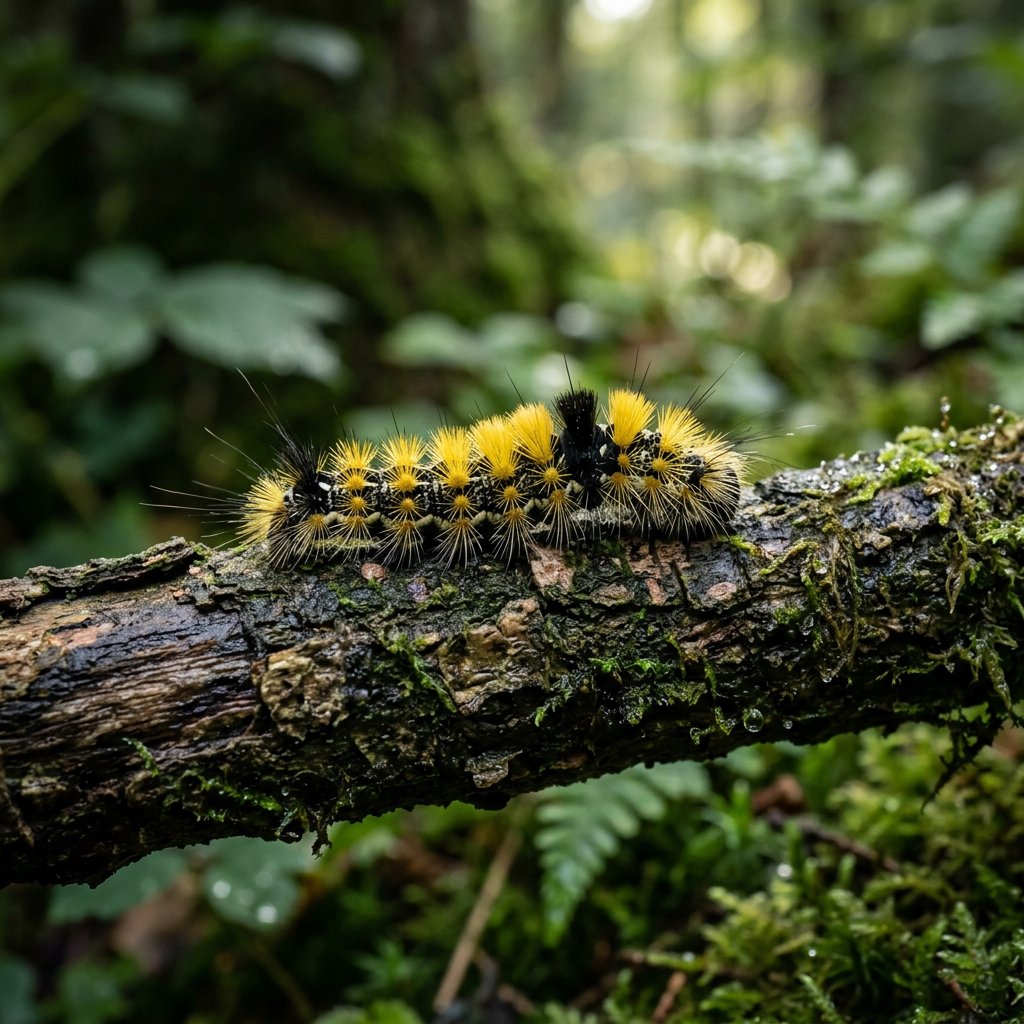
The Scarce Dagger (Acronicta auricoma) is a master of disguise often found resting on the bark of deciduous trees across Europe and Northern Asia. Known for its sophisticated, lichen-mimicking patterns, this moth is a subtle resident of our woodlands and gardens. While the adult is a master of camouflage, its colorful caterpillar is a bold contrast, signaling its presence with bright tufts of hair.
🔍 How to Identify
- 🦋 Forewings: The wings are a dappled mixture of pale and dark grey, featuring distinct black markings that resemble small "daggers" or the Greek letter psi ($\psi$).
- 🐛 The Larva: The caterpillar is unmistakable—dark-bodied with a row of vibrant orange or reddish-brown warts, each sprouting tufts of yellowish-white hair.
- 📏 Resting Posture: When at rest, it folds its wings in a roof-like shape over its body, blending seamlessly into the texture of tree bark or stone walls.
🌲 Habitat & Ecology
- 🌳 Dietary Habits: The larvae are versatile eaters, frequenting a variety of host plants including Birch, Oak, Bramble, and Willow. They play a vital role in the food web, converting leaf matter into energy for birds and bats.
- 🌙 Night Owls: As a nocturnal species, the Scarce Dagger is most active during the twilight hours. It is frequently attracted to light sources and "sugaring" (sweet baits left by moth enthusiasts).
⚠️ Safety & Toxicity
- 🟡 Status: Generally harmless to humans, but the caterpillar requires a "hands-off" approach.
- 🤚 Skin Irritation: Like many members of the Acronicta genus, the caterpillar’s hairs can be urticating. Touching them may cause a mild, itchy rash or skin irritation for sensitive individuals and curious pets.
✨ Fun Fact
The "Dagger" moths get their name from the sharp, black streaks on their wings. If you look closely at the wing of a Scarce Dagger, the markings look remarkably like a tiny, ornate hilt and blade, a design that helps break up its silhouette against the rough texture of a tree.
More Details








