Info
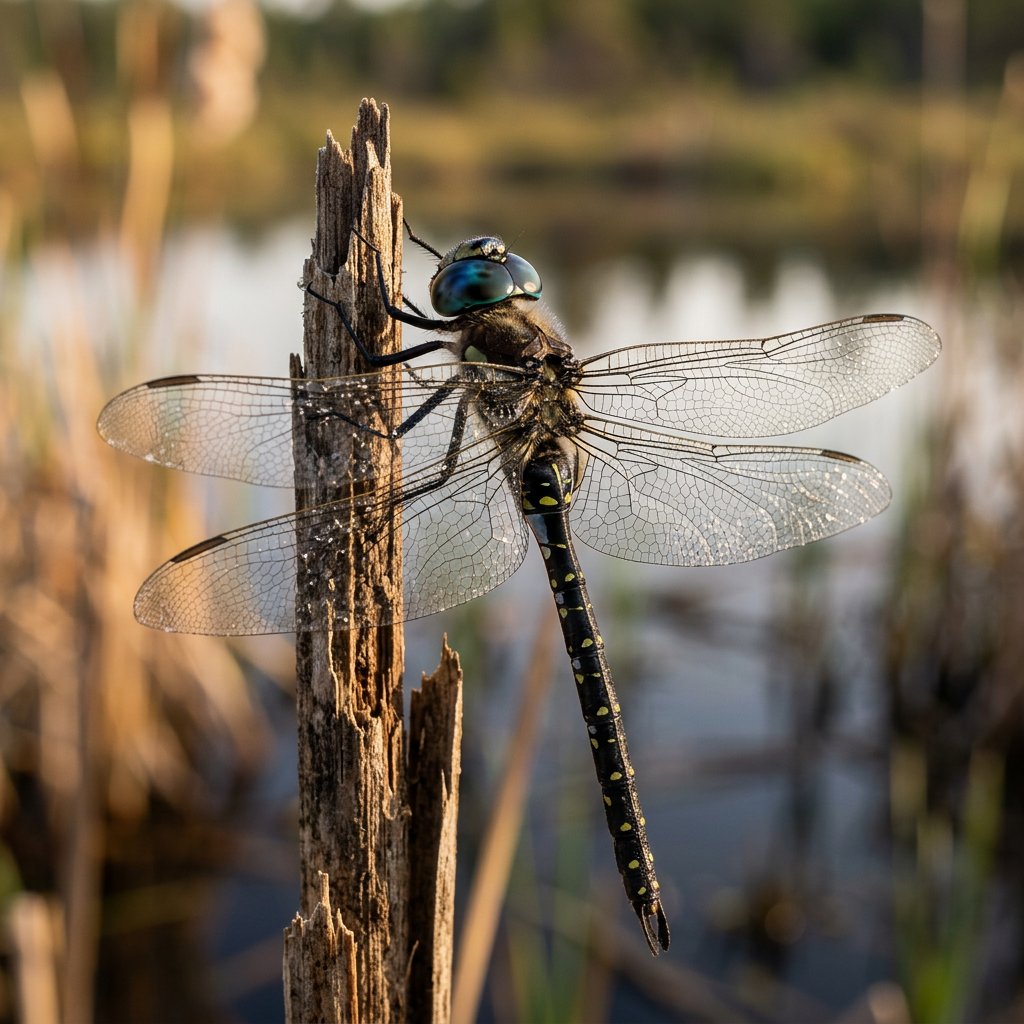
The Canada Darner (Aeshna canadensis) is a sapphire-and-emerald jewel of the northern skies. Often called "darning needles" due to an old folk myth that they would sew up the ears of naughty children, these dragonflies are actually benevolent aerial acrobats. They are a welcome sight near any water source, acting as one of nature's most efficient and beautiful forms of pest control.
🔍 How to Identify
- 👀 The Mosaic Eyes: They possess massive, wrap-around compound eyes that meet at the top of the head, providing a nearly 360-degree field of vision to spot prey and predators alike.
- 🎨 Thoracic Stripes: Look closely at the side of the "chest" (thorax). The first of the two pale stripes usually features a deep, U-shaped notch or "dent" in the middle, a key identifier for this specific species.
- 💎 Tapered Abdomen: Males sport a mosaic of bright blue spots against a dark brown or black body, while females are more variable, appearing with green, yellow, or blue markings.
🌲 Habitat & Ecology
- 🦟 The Mosquito Hunter: These insects are high-speed predators that "hawk" for prey. They catch midges, flies, and mosquitoes mid-air, forming a "basket" with their spiny legs to scoop insects right out of the sky.
- 🍂 Late Season Flyers: Unlike many dragonflies that vanish in mid-summer, the Canada Darner is cold-tolerant. You can often see them patrolling the edges of beaver ponds, bogs, and forest clearings well into the chilly days of autumn.
⚠️ Safety & Toxicity
- 🛡️ Friend, Not Foe: Despite their intimidating size and the "needle" nickname, Canada Darners do not have a stinger. They are completely non-toxic and pose no threat to humans, pets, or garden plants.
- 🦷 Handle with Care: While they are not aggressive, they have strong mandibles designed for crunching beetle shells. If you catch one and handle it roughly, it may give a tiny defensive nip, though it is rarely strong enough to break the skin.
✨ Fun Fact
A Canada Darner's brain processes visual information so quickly that it perceives the world in "slow motion" compared to humans. This allows them to calculate the flight path of a fly and intercept it in mid-air with a 95% success rate—making them one of the most successful predators on Earth!
More Details








