Info
Known as the Poison Hemlock Moth, this tiny lepidopteran is a specialist with a very dangerous diet. While most creatures avoid the deadly Poison Hemlock plant, this moth has evolved to call it home, making it a "biological control" hero in areas where the invasive weed has taken over. It spends its days masquerading as a piece of bark, hiding its fascinating relationship with one of history's most famous toxins.
🔍 How to Identify
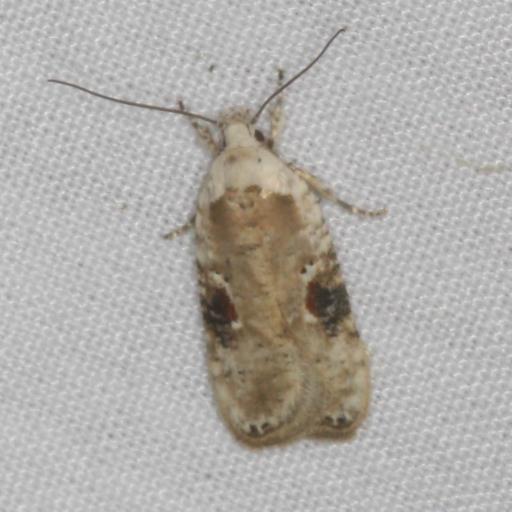
- 🦋 Flat Profile: When resting, it holds its wings flat over its back, giving it a distinctive "squashed" or "stealth-bomber" appearance typical of the Depressariidae family.
- 🎨 Mottled Camouflage: The forewings are a complex mix of creamy tan, grey, and reddish-brown, often marked by two or three prominent dark spots near the center.
- 🎭 Curved Palps: If you look closely at its face, you’ll see "labial palps" that curve upward like tiny, delicate horns or tusks.
🌲 Habitat & Ecology
- 🌿 The Hemlock Specialist: You will almost exclusively find this moth near Poison Hemlock (Conium maculatum). The caterpillars are leaf-rollers, spinning silk to pull the plant's leaves together into a protective tube where they feed safely.
- 🕸️ Social Feeders: In the early stages, several caterpillars may share a single leaf-nest, skeletonizing the foliage and potentially killing the host plant if the infestation is heavy enough.
- 🗺️ European Immigrant: Originally from Europe, this moth was accidentally introduced to North America in the 1970s and has since spread rapidly across the continent following its favorite food source.
⚠️ Safety & Toxicity
- 🦋 Harmless to Touch: The moth itself is not venomous or toxic to humans. It does not bite or sting, and handling the adult moth is safe for your skin.
- 🛑 Guilt by Association: While the moth is safe, its host plant—Poison Hemlock—is deadly if ingested. If you are looking for these moths or their caterpillars, be extremely careful not to touch the plant with bare skin, as the sap can cause reactions in some people, and it is fatal if it enters the bloodstream or mouth.
✨ Fun Fact
The Poison Hemlock Moth is so effective at eating its host that scientists have studied using it as a "green weapon" to wipe out invasive hemlock populations without using chemical herbicides!
More Details








