Info
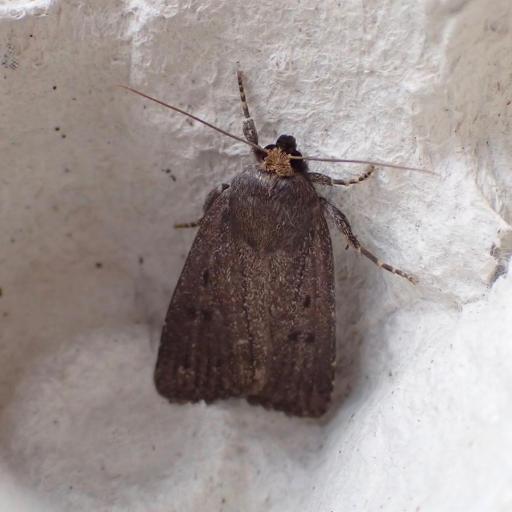
Often referred to as the Mouse Moth, this elusive flyer is a master of shadows. It earns its nickname not just from its drab, mousy-brown color, but from its peculiar habit of scurrying away on its legs rather than taking flight when it feels threatened. If you disturb one in your garden shed, don't be surprised if it "runs" for cover like a tiny rodent!
🔍 How to Identify
- 🦋 The Wings: The forewings are a deep, satiny "sooty" brown with a distinct greasy or metallic sheen that reflects light in the dark.
- ⚫ The "Face" Markings: Look for three small, dark spots positioned near the center of each forewing. They are often arranged in a triangle, resembling a tiny, simplified face.
- 🏃 Behavioral Clue: This moth is a specialist in "crevice-skulking." It has a remarkably flat body, allowing it to squeeze into impossibly tight cracks in bark or buildings.
🌲 Habitat & Ecology
- 🍂 A Generalist Eater: As caterpillars, they aren't picky. they feast on a wide variety of plants including Hawthorn, Willows, and garden herbs like Fennel and Salad Burnet.
- 🏚️ Urban Dwellers: You are most likely to encounter them in late summer (July to September). They love man-made structures and are frequently found hiding behind window shutters, under loose roof tiles, or in woodpiles.
- 🌙 Nocturnal Life: While they are attracted to light, they are even more attracted to "sugar" (fermenting fruit or nectar), making them a common sight for gardeners who leave out overripe fruit.
⚠️ Safety & Toxicity
- 🛡️ Status: Completely harmless to humans and pets.
- 🚫 No Defense Weapons: The Mouse Moth does not bite, sting, or carry any known toxins. Their only defense is their camouflage and their ability to run quickly into the darkness.
- 🌿 Garden Impact: While the larvae eat leaves, they rarely appear in high enough numbers to cause significant damage to ornamental plants or crops.
✨ Fun Fact
The scientific name tragopoginis comes from the plant Tragopogon (Goat's-beard). Early naturalists believed this was the moth's favorite food, but we now know this "mouse" is happy to snack on almost any greenery it finds!
More Details








