Info
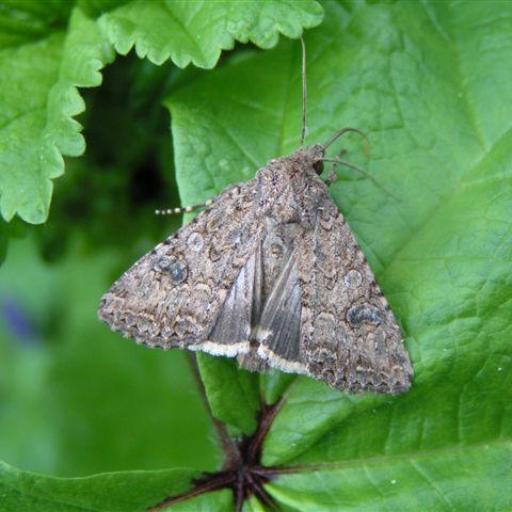
The Nutmeg moth (Anarta trifolii) is a master of disguise often found resting on wooden fences or tree bark, where its mottled wings make it nearly invisible. Named for its earthy, spice-like coloration, this moth is a common visitor to gardens and meadows across the Northern Hemisphere. While it might look like a simple "brown moth" at first glance, its intricate patterns tell a story of evolutionary camouflage.
🔍 How to Identify
- 🦋 Forewings: The upper wings are a blend of grey and reddish-brown, featuring a distinct, pale "W" shaped line near the outer edge and two prominent spots known as the "kidney" and "oval" marks.
- 🕊️ Hindwings: When it takes flight, you may notice paler whitish or light-grey hindwings that contrast sharply with a broad, dark smoky-brown border.
- 🐛 The Caterpillar: The larvae are usually bright green or pinkish-brown with a bold yellow stripe running down their sides, often found tucked away near the base of their host plants.
🌲 Habitat & Ecology
- 🍽️ Dietary Generalist: The caterpillars are not picky eaters; they feast on a wide range of plants, including clover (which gives them their species name trifolii), beetroots, and "weedy" species like fat-hen and saltbush.
- 🌙 Nocturnal Life: As adults, they are active at night and are highly attracted to light. They play a quiet but important role as nocturnal pollinators, visiting garden flowers while most of the world is asleep.
⚠️ Safety & Toxicity
- ✅ Harmless: The Nutmeg moth is completely safe for humans and pets. They do not bite, sting, or carry toxins.
- 🌱 Garden Impact: While the caterpillars are technically "pests" in agricultural settings (particularly for beet crops), in a home garden, they rarely occur in high enough numbers to cause significant damage and serve as a vital food source for birds and bats.
✨ Fun Fact
The Nutmeg is a "double-brooder," meaning it produces two generations of offspring every year—one that emerges in the late spring and a second that appears in the heat of mid-to-late summer!
More Details








