Info
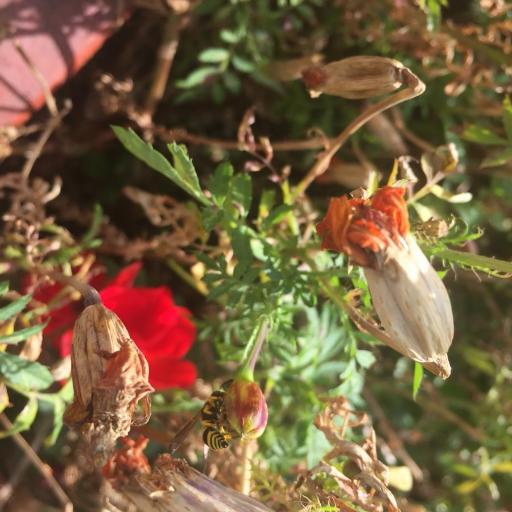
Often mistaken for a common yellowjacket due to its striking yellow-and-black wardrobe, the European Tube Wasp (Ancistrocerus gazella) is actually a solitary "mason" of the insect world. Though its name sounds like a botanical entry, this "Gazelle" of the wasp world is a graceful, non-aggressive architect that gardeners should welcome with open arms.
🔍 How to Identify
- 🐝 The Patterns: It features bold, alternating bands of bright yellow and deep black. Look for a specific "V" or "U" shaped mark on its thorax.
- 📏 Slender Profile: It has a much thinner "waist" and a more delicate, elongated body (about 11–15mm) compared to the bulkier social hornets.
- 🛠️ The Masonry: You can often identify them by their work—they create neat mud partitions inside hollow twigs, plant stems, or even the "bug hotels" humans hang in gardens.
🌲 Habitat & Ecology
- 🐛 The Caterpillar Hunter: This wasp is a natural pest controller. The female hunts small caterpillars, paralyzing them with a precise sting before dragging them back to her mud-walled nursery to serve as a "living larder" for her larvae.
- 🏠 Solitary Lifestyle: Unlike yellowjackets, they do not live in large, angry colonies. Each female works alone, meaning there is no "hive" to defend and no swarming behavior to worry about.
⚠️ Safety & Toxicity
- 🛡️ Low Risk: These wasps are exceptionally docile. Because they have no queen or colony to protect, they will almost never sting unless you physically catch them in your hand or step on them.
- 🩹 The Sting: If you are stung, the sensation is similar to a mild bee sting. While not life-threatening for most, those with known wasp venom allergies should still exercise standard caution.
✨ Fun Fact
The Ancistrocerus gazella is a world traveler! Originally from Europe, it was accidentally introduced to New Zealand and North America, where it has become one of the most successful urban "pioneer" species, helping gardeners across the globe manage leaf-rolling caterpillars.
More Details








