Info
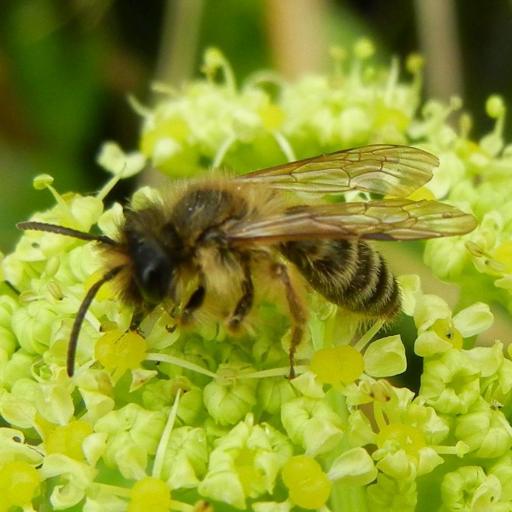
Often called the Yellow-legged Mining Bee, this fuzzy little worker is a true "friend" of the gardener. It is one of the most common solitary bees found across Europe and North Africa, frequently seen darting between spring blossoms. Unlike social honeybees, these bees are independent spirits, though they often choose to live in large "neighborhoods" with their own private burrows close together.
🔍 How to Identify
- 🐝 Abdominal Bands: Look for distinct, pale yellow-to-white bands of hair on the dark segments of its abdomen, which become more prominent as the bee matures.
- 🦵 Golden Leggings: The hind legs are covered in dense, bright orange or yellow hairs used for carrying pollen. This "pollen basket" is their most defining feature.
- 📏 Size & Shape: They are slightly smaller and more compact than a standard honeybee, with a somewhat flattened, oval-shaped body.
🌲 Habitat & Ecology
- 🏘️ The Mining Lifestyle: As their name suggests, these bees are "miners." They dig neat, circular tunnels in light, sandy soil or short-grass lawns, often favoring sunny, south-facing slopes.
- 🌸 Two Seasons of Work: This species is "bivoltine," meaning it produces two generations a year. You’ll see the first group in early spring (March–May) and a second group in mid-summer (July–August).
- 🌻 Generalist Pollinators: They aren't picky eaters! They are vital for pollinating a huge variety of plants, from backyard dandelions and daisies to commercial fruit trees like apples and cherries.
⚠️ Safety & Toxicity
- 😇 Peaceful Pollinator: These bees are exceptionally docile. Because they don't have a central hive or "queen" to defend, they have no reason to be aggressive toward humans or pets.
- 🛡️ Weak Stinger: While females do possess a stinger, it is very small and weak. It is rarely capable of penetrating human skin and is only used if the bee is being physically crushed. They are 100% safe to have around children and curious dogs.
✨ Fun Fact
The Yellow-legged Mining Bee is often a "host" to the Painted Nomad Bee, a "cuckoo bee" that sneaks into the Andrena’s burrow to lay its own eggs, leaving the hardworking Yellow-legged bee to do all the childcare!
More Details








