Info
Commonly known as the Knopper Gall Wasp, this tiny architect is famous not for its own appearance, but for the strange, alien-looking "sculptures" it forces oak trees to grow. Arriving in Britain and parts of Europe relatively recently, it has become a staple of autumn walks, turning ordinary acorns into sticky, ridged masterpieces known as Knopper galls. While the wasp itself is elusive, its impact on the forest floor is unmistakable and fascinatingly complex.
🔍 How to Identify
- 🐝 The Adult Wasp: A tiny, inconspicuous dark wasp (about 2mm long). You are unlikely to see the adult unless you are looking very closely at oak buds in the spring.
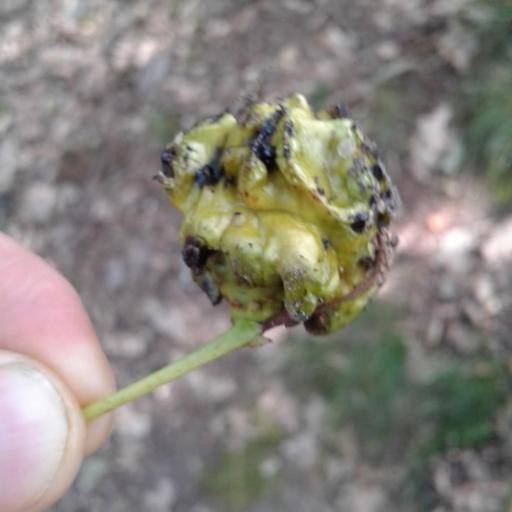
- 🧶 The Gall: The most recognizable feature is the "Knopper gall" on acorns. These are heavy, woody, and distorted growths with irregular ridges and deep furrows, often looking like a burst popcorn kernel or a crumpled hat.
- 🍯 Texture and Color: Young galls are sticky to the touch and bright green, often tinged with red. As they mature and fall to the ground, they turn a woody brown and become very hard.
🌲 Habitat & Ecology
- 🌳 The Two-Tree Strategy: This insect has a high-society lifestyle that requires two specific trees: the Turkey Oak and the Common (Pedunculate) Oak. The wasp alternates between these two species to complete its complex life cycle; without the Turkey Oak nearby to host the spring generation, the Knopper galls won't appear on the common oaks.
- 🍃 Nurturing the Larva: Inside each sticky gall is a single larva. The wasp injects chemicals into the developing acorn that "hijack" the tree's DNA, forcing it to grow a protective, nutrient-rich home for the wasp's offspring instead of a seed.
⚠️ Safety & Toxicity
- 🛡️ Safe for Humans: The Knopper Gall Wasp is a "friend" to the curious observer. It cannot sting or bite humans or pets, and it lacks any defensive venom.
- 🍂 Impact on Trees: While a heavy infestation can prevent a tree from producing viable acorns (affecting the tree's ability to reproduce), it does not harm the overall health or lifespan of the massive oak trees it inhabits.
✨ Fun Fact
The name "Knopper" comes from the German word Knoppe, which refers to a type of felt cap or large button worn on traditional clothing in the 17th century, which the gnarled gall was thought to resemble!
More Details








