Info
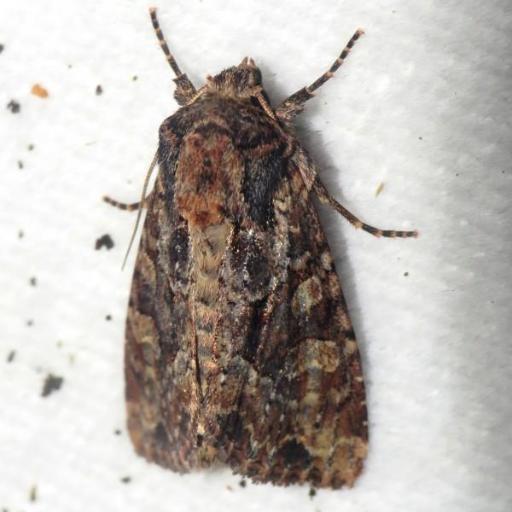
Known as the Dusky Brocade, this moth is a master of disguise, blending seamlessly into tree bark and dry autumn leaves. A common visitor to suburban gardens throughout Europe and parts of Asia, it belongs to the Noctuidae family, often called "owlet moths" because of their nocturnal habits and glowing eyes when caught in a beam of light. While it may look like a simple brown moth at first glance, its wings hold the intricate patterns of a finely woven tapestry.
🔍 How to Identify
- 🦋 Forewings: The wings feature a "marbled" or "brocade" texture, typically showing a mix of earthy browns, muted greys, and occasionally a soft reddish-ochre tint.
- 🎭 Distinct Markings: Look closely for two specific shapes on the upper wing: a circular "orbicular" spot and a kidney-shaped "reniform" spot, which are hallmark traits of this species.
- 📏 Resting Shape: When at rest, it folds its wings into a flat, roof-like triangle over its body, completely concealing its paler, less-patterned hindwings.
🌲 Habitat & Ecology
- 🌾 The Grassland Diet: Unlike some "pest" caterpillars that eat prize roses, the larvae of the Dusky Brocade are specialized grass-feeders. They prefer various meadow grasses, making them vital members of meadow and marshland ecosystems.
- 🌙 Night Shift: This insect is strictly nocturnal. During the day, it hides in dense herbage or against bark. At night, it is highly attracted to artificial lights and fermented sugar baits used by moth enthusiasts.
⚠️ Safety & Toxicity
- ✅ Harmless Friend: The Dusky Brocade is entirely safe for humans. It does not bite, sting, or possess any irritating hairs (urticating hairs) found on some other caterpillars.
- 🐾 Pet Neutral: They are non-toxic to cats and dogs. If your pet manages to catch one, the only "danger" is a dusty mess of wing scales on your carpet.
✨ Fun Fact
🎨 The Master of Variation: This species is famously "polymorphic," meaning two individuals can look like completely different species! Some are pale and sandy with sharp markings, while others are dark, smoky, and almost patternless—a clever evolutionary trick to stay hidden in different environments.
More Details








