Info
Often called the "World's Hardest Worker," the Western Honey Bee is perhaps the most famous insect on Earth. While it spends its entire life dancing among your flowers, it is important to note that Apis mellifera is an insect, not a plant. From ancient Egyptian mythology—where they were believed to be the tears of the sun god Ra—to their vital role in modern agriculture, these tiny golden laborers are the most essential friends a gardener can have.
🔍 How to Identify
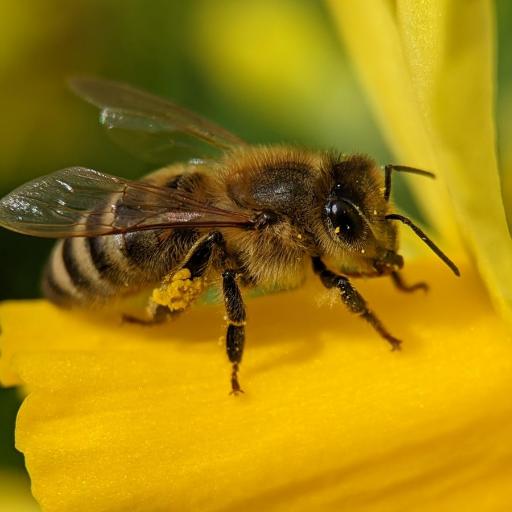
- 🐝 Golden Stripes: A distinctive abdomen featuring alternating bands of dark brown and golden-amber. Their colors can vary slightly depending on the specific subspecies (like Italian or Carniolan bees).
- 🧶 Fuzzy Thorax: Their mid-section is covered in dense, velvet-like hairs. These hairs are actually branched (plumose), acting like a magnet for pollen grains.
- 🧺 Pollen Baskets: On their hind legs, they possess "corbiculae"—flat, fringed areas where they pack moistened pollen into bright yellow or orange balls to carry back to the hive.
🌲 Habitat & Ecology
- 🌻 Master Pollinators: They are generalist foragers, meaning they aren't picky. They visit hundreds of different plant species, facilitating the reproduction of about 80% of the world's flowering crops.
- 🏰 Social Architects: Unlike solitary bees, these insects live in highly organized colonies. They build intricate hexagonal wax combs to store honey and raise their young, maintaining a perfect internal temperature regardless of the weather outside.
⚠️ Safety & Toxicity
- 🛡️ Docile Temperament: Honey bees are generally very peaceful. They are "focused on the mission" and will usually ignore humans unless their hive is directly threatened or they are accidentally stepped on.
- 🩹 The Barbed Stinger: A honey bee can only sting once. Their stinger is barbed and stays in the skin, which unfortunately causes the bee to perish after the encounter.
- 🚫 Allergy Alert: For most, a sting causes minor localized swelling and pain. However, for those with a bee venom allergy, a sting can be life-threatening and requires immediate medical attention (EpiPen).
✨ Fun Fact
- 💃 The Waggle Dance: Honey bees are one of the few non-primates that use a symbolic language! To tell their sisters exactly where a patch of flowers is located, they perform a "Waggle Dance," using the angle of the sun and the duration of their shimmy to communicate distance and direction.
More Details








