Info
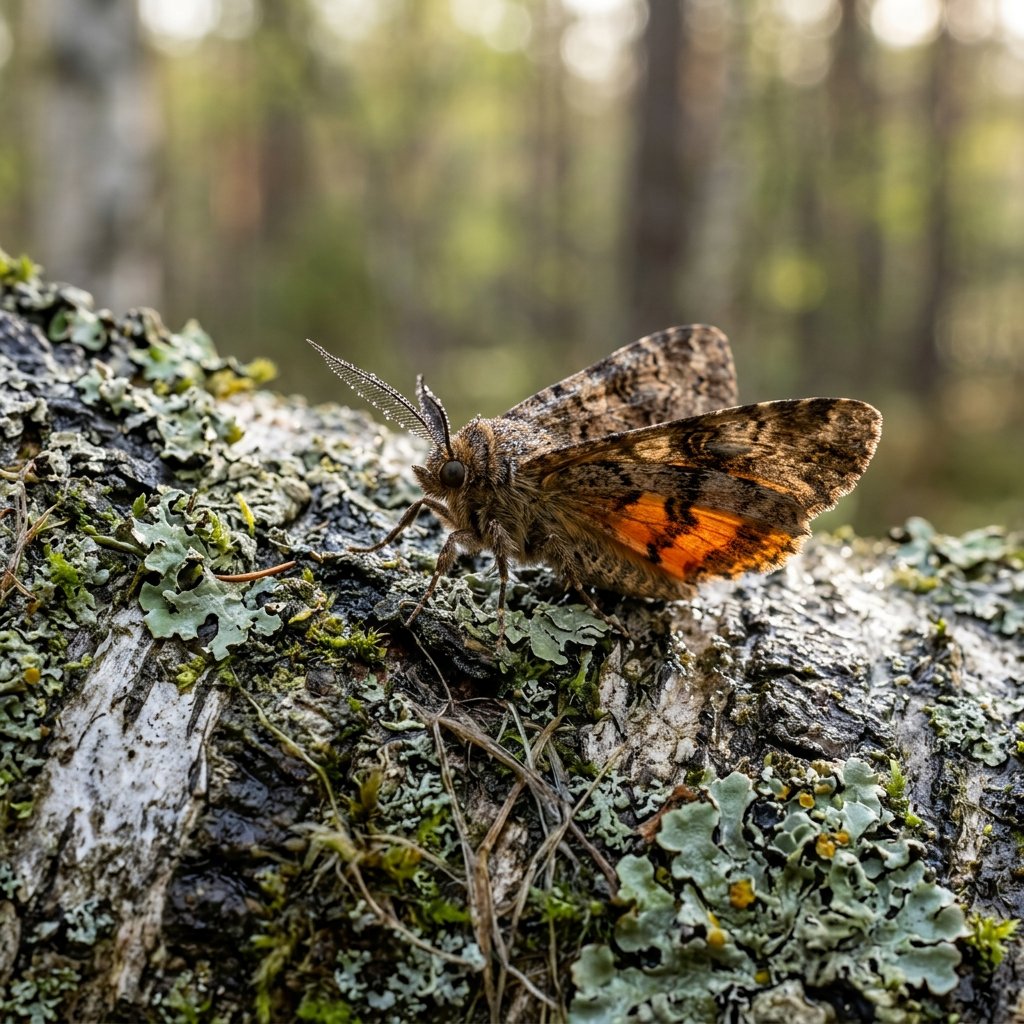
The Orange Underwing (Archiearis parthenias) is a master of disguise and a true "early bird" of the insect world. Often appearing while the air is still crisp and the trees are bare, this day-flying moth is frequently mistaken for a small butterfly as it flits through birch woodlands. It is widely considered a charming herald of spring, signaling the end of winter's slumber with its sudden bursts of hidden color.
🔍 How to Identify
- 🦋 The Secret Wings: When resting, its forewings are a mottled, drab grey-brown that perfectly mimics tree bark. However, when it takes flight, it reveals brilliant, orange-and-black hindwings that flash like a tiny flame.
- 🌿 Feathery Antennae: Males possess noticeably "combed" or feathery antennae, which they use to sniff out the pheromones of females drifting through the canopy.
- 📏 Resting Posture: Unlike most butterflies that hold their wings upright, the Orange Underwing rests with its wings flat or tilted in a roof-like shape, characteristic of the Geometrid moth family.
🌲 Habitat & Ecology
- 🌳 The Birch Connection: This moth is a specialist; it is almost exclusively found near Birch trees (Betula). The larvae feed on birch catkins and young leaves, while the adults enjoy basking on the sunny upper branches of these trees.
- ☀️ Sun Seeker: You will rarely find this moth active at night. It is strictly "diurnal," meaning it loves the sunshine. On warm March or April days, you can spot them zig-zagging high up in the canopy, occasionally descending to the ground to drink from damp patches of mud.
- 🍂 Camouflage Strategy: Their dull outer wings are a defensive evolution. When a predator like a bird spots the flash of orange and tries to follow it, the moth lands and "disappears" against the bark by closing its wings, leaving the predator confused.
⚠️ Safety & Toxicity
- ✅ Harmless Friend: The Orange Underwing is completely harmless to humans. It does not bite, sting, or carry any known toxins.
- 🐶 Pet Safe: There are no reported toxicity issues regarding cats or dogs. If your pet manages to catch one, the only real harm is to the moth itself!
- 🧤 Gentle Touch: Like all moths, their wings are covered in tiny, delicate scales. Handling them can damage their ability to fly, so it is best to observe their beauty from a short distance.
✨ Fun Fact
The Orange Underwing has a "look-alike" cousin called the Light Orange Underwing. They are so similar that experts often have to look at their antennae under a magnifying glass to tell them apart—but a good clue is the tree! The Light Orange Underwing prefers Aspen trees, while the standard Orange Underwing sticks strictly to Birch.
More Details








