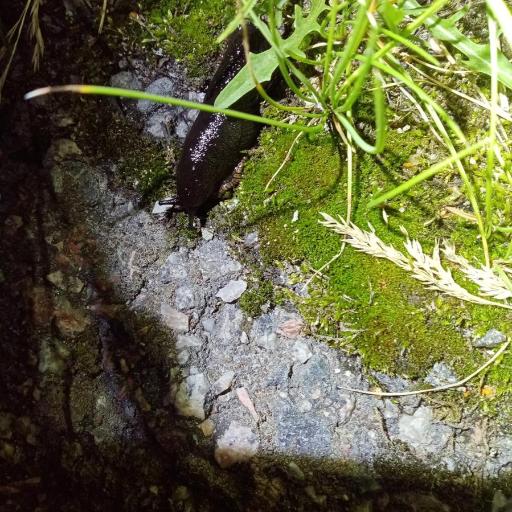
Info
Often called the "European Black Slug" or the "Licorice Slug," Arion ater is a giant of the undergrowth. While frequently mistaken for a large insect, this creature is actually a terrestrial gastropod mollusk—essentially a snail that evolved to travel light by ditching its shell. In the damp woodlands of Europe and the Pacific Northwest, they act as the forest's "cleanup crew," processing decaying matter with surprising efficiency.
🔍 How to Identify
- 🐌 The Body: These slugs are massive, often reaching 4 to 6 inches (10–15 cm) in length. While usually jet-black, they can sometimes appear in shades of deep chocolate brown or even rust-orange.
- 🕳️ The Breathing Hole: Look at the right side of the "mantle" (the smooth shield-like area behind the head). You will see a distinct opening called a pneumostome, which the slug uses to breathe.
- 〰️ Texture and Defense: Their skin is covered in deep, longitudinal ridges. When threatened, they don't just sit there; they contract into a semi-circular ball and may rock rhythmically from side to side to deter predators.
🌲 Habitat & Ecology
- 🍂 The Ultimate Recycler: They are detritivores, meaning they feast on rotting vegetation, fungi, and even animal carcasses. In your garden, they are famous for their "Swiss cheese" approach to hostas and lettuce leaves.
- 💧 Moisture Seekers: Because they lack a shell to prevent drying out, they are strictly nocturnal or active only on rainy days. They spend their sun-drenched hours hiding under logs, deep in compost piles, or tucked into cool, damp crevices.
⚠️ Safety & Toxicity
- 🐾 Pet Warning: While the slug itself isn't "poisonous" to touch, they are known intermediate hosts for Lungworm (Angiostrongylus vasorum). If a curious dog or cat eats one, it can lead to serious respiratory and heart issues.
- 🧼 The Slime Factor: Their mucus is incredibly thick and sticky, containing chemicals that make them taste terrible to birds. If you get it on your skin, it is notoriously difficult to wash off with just water; use a bit of salt or a dry cloth first to "ball up" the slime.
✨ Fun Fact
The slime produced by a Black Slug is a biological marvel. It acts as both a lubricant to help them glide over sharp thorns and an adhesive that allows them to crawl straight up vertical walls or even hang upside down!
More Details








