Info
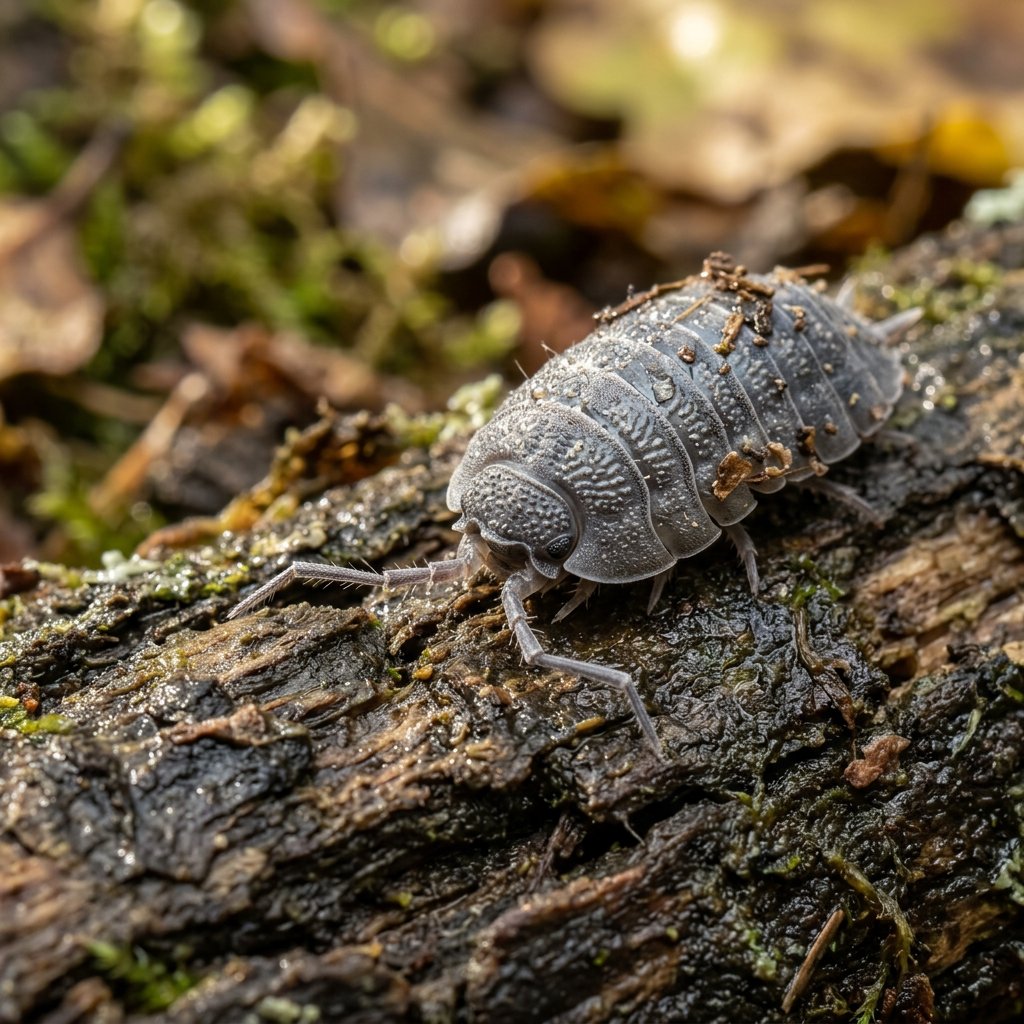
Commonly called the "Nosey Pillbug," this charming little land-crustacean is one of nature’s most effective tiny recyclers. While it looks like a miniature tank from a sci-fi movie, it is actually a terrestrial isopod—a cousin of the shrimp—that has traded the ocean for the damp corners of your garden. They are the quiet janitors of the undergrowth, tirelessly turning fallen leaves into nutrient-rich soil.
🔍 How to Identify
- 👃 The "Nose": The most distinguishing feature is a prominent, square-shaped ridge projecting from the front of its head, giving it a distinct "snout" compared to other pillbugs.
- 🛡️ Body Armor: It possesses a segmented, matte exoskeleton that is usually grey or brownish, often decorated with subtle pale mottling or longitudinal stripes.
- 🌀 The Semi-Roll: While it can roll into a ball (volvation) for protection, it is less "perfect" than its cousins; because of its nose, it usually leaves a tiny gap and cannot form a completely seamless sphere.
🌲 Habitat & Ecology
- 🍂 Nature's Recycler: These isopods are detritivores, meaning they feast exclusively on decaying organic matter. They play a vital role in breaking down leaf litter and returning minerals to the earth.
- 💧 Moisture Seekers: Because they breathe through delicate, gill-like structures, they require high humidity to survive. You will find them huddled together under damp logs, large stones, or buried deep within compost piles to stay hydrated.
⚠️ Safety & Toxicity
- 🛡️ Completely Harmless: The Nosey Pillbug is a "friend" in every sense. They do not bite, sting, or produce any toxins, making them perfectly safe to handle for curious children or hobbyists.
- 🐶 Pet & Garden Safe: They are non-toxic to dogs and cats. In the garden, they rarely bother living plants, preferring the "junk" of the garden like rotting wood and dead leaves.
✨ Fun Fact
Even though they live on land, Armadillidium nasatum never truly left the sea behind; they still possess "pleopodal lungs" on their underside that must stay moist to function, essentially meaning they are "breathing" through a thin film of water at all times!
More Details








