Info
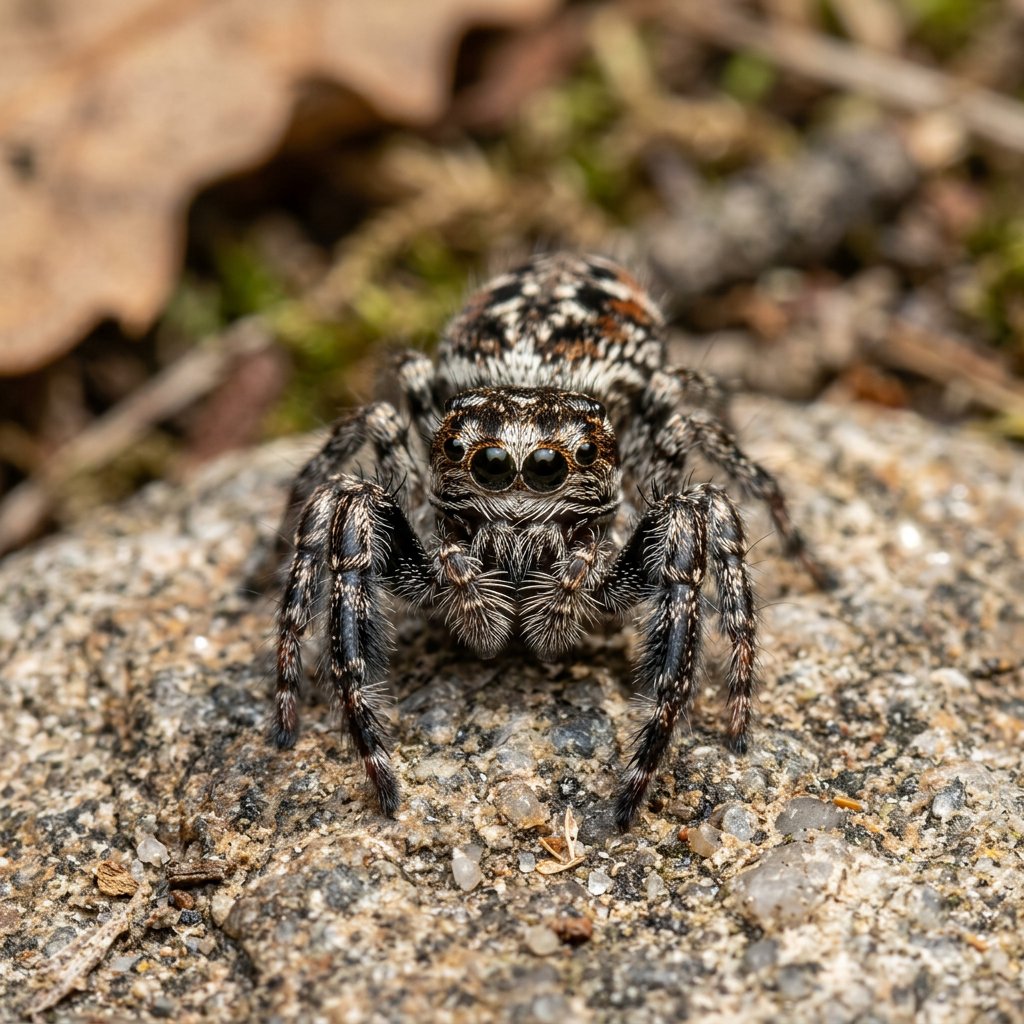
The Asian Jumping Spider, often called the "Tiny Acrobat," is a charismatic little hitchhiker that traveled from Northeast Asia to become a common resident in North American homes and gardens. Unlike many spiders that hide in dark, dusty corners, this species loves the light and is often seen patrolling sunlit walls or window sills. It is a curious, intelligent predator that acts more like a tiny, eight-legged cat than a traditional web-weaver.
🔍 How to Identify
- 👁️ The "Goggles": Features two massive, forward-facing primary eyes that give it an almost "cute" or inquisitive expression, flanked by smaller eyes that provide nearly 360-degree vision.
- 🎨 Speckled Camouflage: Its body is covered in a dense coat of grey, tan, and dark brown hairs, creating a mottled, "salt and pepper" pattern that helps it blend into concrete or tree bark.
- 🦵 Stocky Frame: It has a compact, slightly flattened body with thick, powerful legs designed for explosive jumping rather than scurrying.
🌲 Habitat & Ecology
- 🏠 Urban Adventurer: These spiders are "synanthropic," meaning they have adapted beautifully to living alongside humans. You’ll frequently find them on the exterior of buildings, near porch lights where insects gather, or indoors on vertical surfaces.
- 🏹 The Precision Hunter: They do not spin webs to catch food. Instead, they stalk their prey—usually small flies, gnats, or mosquitoes—and pounce with incredible accuracy from several inches away. Before they leap, they always attach a silken "safety line" to the surface in case they miss.
⚠️ Safety & Toxicity
- ✅ Status: Completely harmless and widely considered a beneficial "spider friend" for natural pest control.
- 🛡️ Details: While they are technically capable of biting if pinched or handled roughly, they are extremely shy and will almost always choose to jump away from humans. Their venom is not medically significant and is less painful than a mild bee sting, posing no threat to healthy adults, children, or pets.
✨ Fun Fact
Jumping spiders like Attulus fasciger don't actually have big muscles in their legs to jump. Instead, they use a "hydraulic" system, rapidly increasing the fluid pressure in their legs to snap them straight and launch themselves up to 50 times their own body length!
More Details








