Info
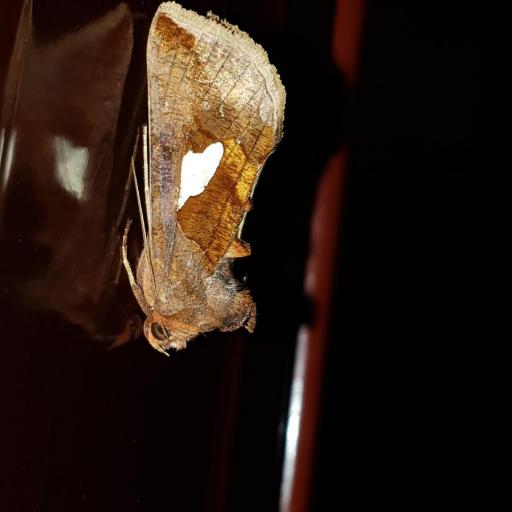
Often called the Gold Spangle, this shimmering moth looks as though a jeweler dropped a leaf of 24-karat gold onto its wings. Found across Europe and Asia, it is a master of camouflage that blends perfectly into dried foliage until the light hits its metallic "autograph," making it a favorite find for nighttime nature enthusiasts.
🔍 How to Identify
- ✨ The Gold Patch: The most striking feature is a large, irregularly shaped, metallic golden spot (or "spangle") located in the center of each forewing.
- 🍂 Wing Patterns: The rest of the wing is a rich, marbled blend of purplish-brown and deep bronze, mimicking the texture of a withered autumn leaf.
- 📐 Resting Posture: Like many in its family, it rests with its wings folded in a steep, tent-like shape, often sporting a prominent tuft of hair on its thorax that looks like a tiny "hunchback."
🌲 Habitat & Ecology
- 🌿 Garden Guest: These moths frequent damp meadows, woodland edges, and suburban gardens. Their caterpillars are not picky eaters, munching happily on common plants like stinging nettles, dandelions, and hawkweeds.
- 🌙 Night Owl Behavior: While primarily nocturnal and attracted to garden lights, the Gold Spangle is often seen at dusk hovering near nectar-rich flowers like Honeysuckle or Buddleia to fuel up for the night.
⚠️ Safety & Toxicity
- 🛡️ Safe & Gentle: The Gold Spangle is a "friend" in every sense. It does not bite, sting, or carry any toxins that are harmful to humans or curious pets.
- 🚫 Low Pest Risk: Unlike some of its cousins, it rarely appears in numbers large enough to cause significant damage to garden plants, making it a neutral-to-beneficial part of your local ecosystem.
✨ Fun Fact
The genus name Autographa literally translates to "self-writing." This refers to the distinct metallic markings on the wings of these moths, which often look like a handwritten letter or a mysterious scientific symbol scrawled in gold ink.
More Details








