Info
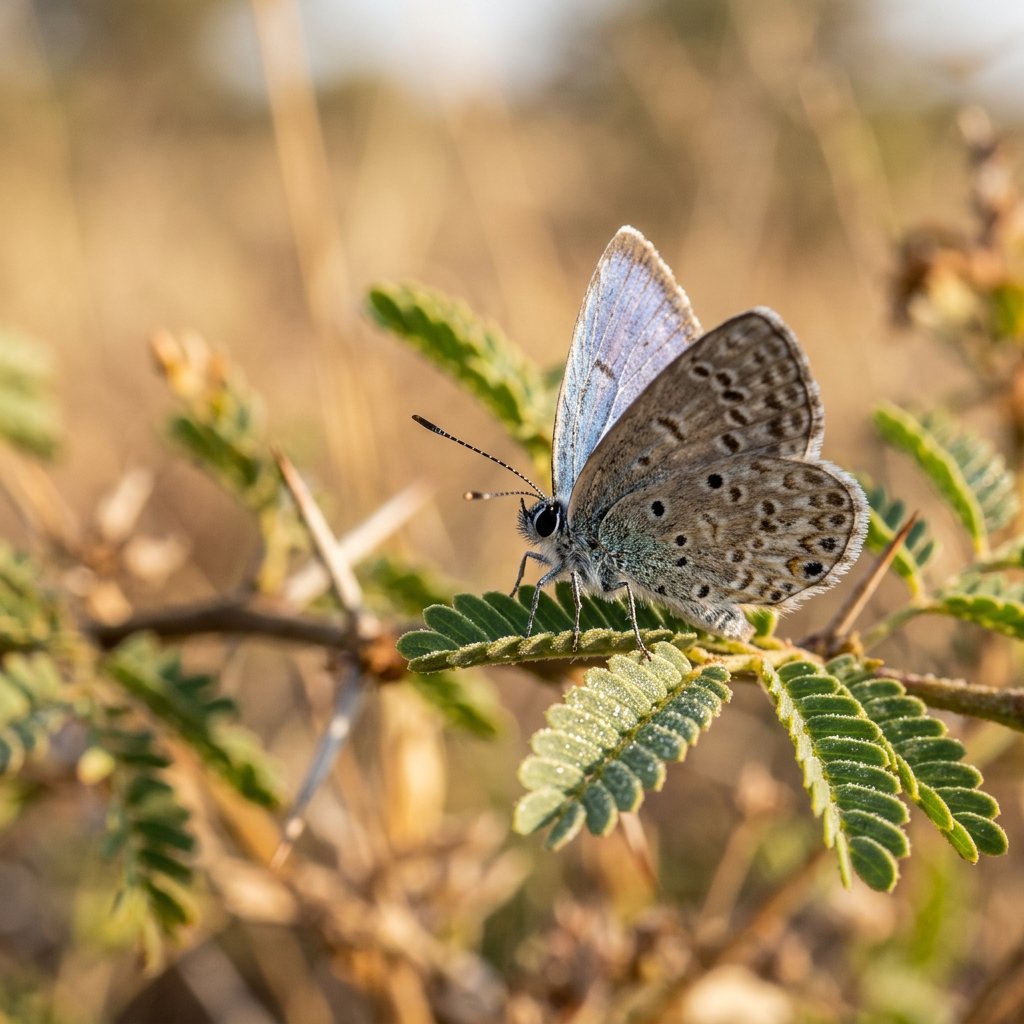
Often called the Desert Babul Blue or the Bright Babul Blue, this tiny lepidopteran is a shimmering gem of the arid world. It spends its life in a delicate dance around thorny scrublands, serving as a reminder that even the harshest, driest environments can host incredible beauty. In many cultures, these "blues" are seen as symbols of the fleeting nature of desert blooms.
🔍 How to Identify
- 🦋 Wing Coloration: Males feature a brilliant, iridescent violet-blue on the upper side of their wings, while females are typically a more muted brown with subtle blue dusting at the base.
- 🔎 Velvet Spots: The underside of the wings is a pale creamy-grey, marked by a distinct pattern of dark brown spots and "velvet" black dots near the wing base.
- 📏 Stature: This is a very small butterfly, often measuring less than 2 centimeters across, making it easy to miss until it suddenly darts into the sunlight.
🌵 Habitat & Ecology
- 🌳 The Acacia Connection: This butterfly is deeply tied to Acacia (Babul) trees. It relies on these thorny plants for survival, as the caterpillars feed almost exclusively on the flower buds and young leaves.
- 🏜️ Heat Specialist: Unlike many butterflies that retreat during the hottest part of the day, the Desert Babul Blue is highly active in bright sunlight, flitting rapidly between sun-drenched branches to find mates or nectar.
⚠️ Safety & Toxicity
- ✅ Harmless Friend: The Desert Babul Blue is completely safe. It does not bite, sting, or possess any toxins that could harm humans or curious pets.
- 🦋 Fragile Scales: While safe to watch, avoid touching their wings. The "dust" on their wings is actually microscopic scales; losing them can hinder their ability to fly and regulate body temperature.
✨ Fun Fact
The caterpillars of this butterfly are "myrmecophilous," meaning they have a symbiotic relationship with ants! The caterpillars secrete a sugary liquid that the ants drink, and in exchange, the ants act as tiny bodyguards, protecting the caterpillars from predators.
More Details








