Info
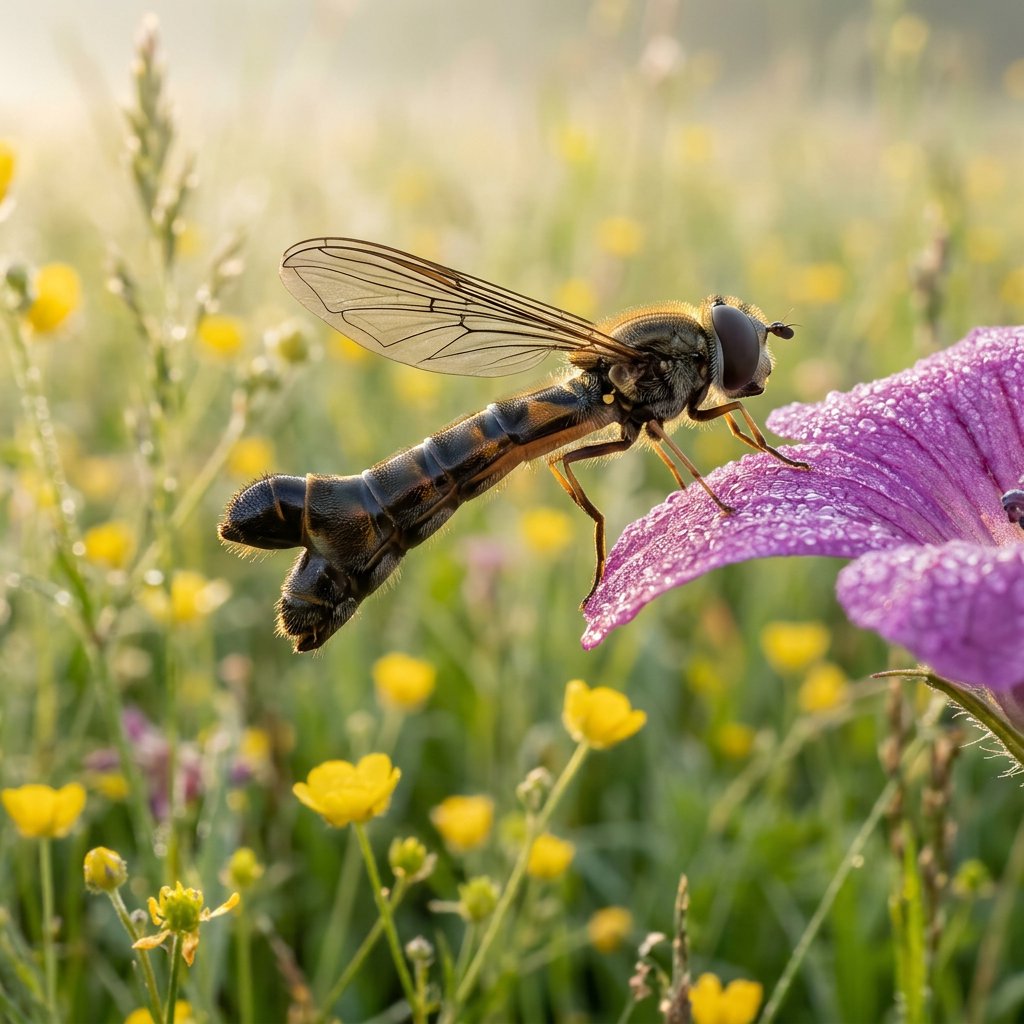
Known as the Slender Hoverfly, this insect is a master of biological disguise. While its needle-thin body might make it look like a fragile wasp or a strange needle floating in the air, it is actually a gentle, highly beneficial member of the fly family. Often found hovering silently in the shadows of a garden, it acts as a "stealth guardian" for your plants.
🔍 How to Identify
- 🦟 The Clubbed Abdomen: Its most striking feature is its incredibly long, thin "waist" that flares out slightly at the end, giving it the appearance of a tiny, flying club.
- 🪽 Ghostly Wings: It has two clear, translucent wings that often have a faint dark smudge on the leading edge, appearing almost invisible when in high-speed motion.
- 👀 Fly-Like Eyes: Unlike the wasps it mimics, it has very large, wrap-around eyes that cover most of its head, a classic trait of the Syrphidae (hoverfly) family.
🌲 Habitat & Ecology
- 🌿 Shadow Dwellers: Unlike many of its cousins who crave bright sunlight, the Slender Hoverfly prefers the "quiet" parts of the garden. You’ll typically find it in dappled shade, under large leaves, or along woodland edges.
- 🛡️ The Aphid Assassin: While the adults spend their time sipping nectar from small white flowers, their larvae are ferocious predators. They hunt aphids across your plants, making them an excellent natural pest control for gardeners.
- 💃 Pulsing Flight: They have a unique way of moving—they don't just fly; they "dance" in the air, hovering perfectly still for several seconds before darting a few inches in another direction.
⚠️ Safety & Toxicity
- 🕊️ Completely Harmless: Despite its vaguely wasp-like silhouette, the Slender Hoverfly is a "friend." It has no stinger, cannot bite, and possesses no venom.
- 🛡️ Visual Bluff: Its only defense is Batesian mimicry—looking just enough like a stinging insect to trick birds and humans into leaving it alone. It is safe for children and pets to be around.
✨ Fun Fact
The larvae of Baccha elongata look almost exactly like tiny, translucent green slugs. They are so well-camouflaged that they often go unnoticed by gardeners, even while they are busy eating hundreds of pests right under the gardener's nose!
More Details








