Info
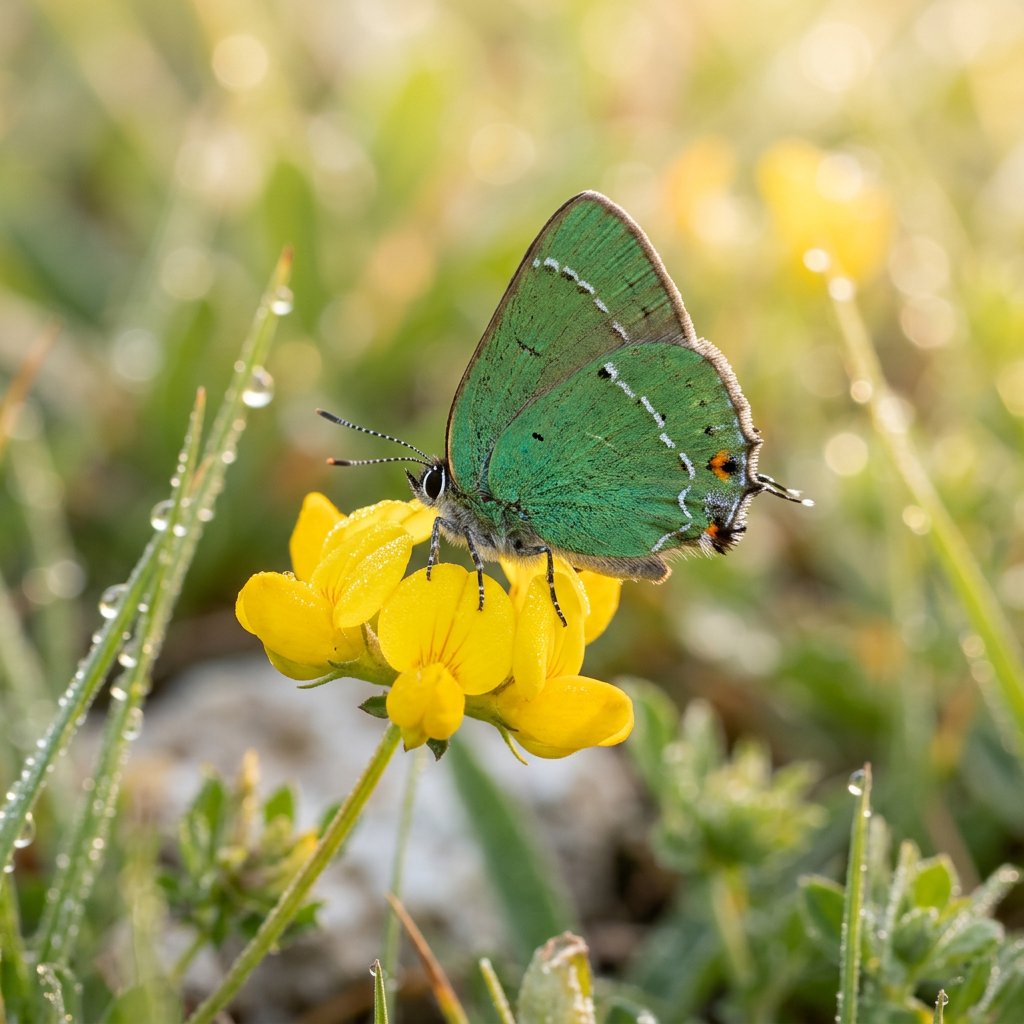
Known as the Green Hairstreak, Callophrys rubi is a tiny living emerald of the insect world. Though you may have found it near your plants, it is actually a butterfly famous for its incredible camouflage. It is often the first butterfly to emerge in the spring, dancing through scrublands and heathlands like a misplaced leaf.
🔍 How to Identify
- 🦋 The "Disappearing" Wing: When resting, it always keeps its wings closed. The undersides are a brilliant, iridescent leaf-green, while the hidden topsides are actually a dull, inconspicuous brown.
- ⚪ The White Streak: Look for a faint, broken line of white dots across the hindwing—this is the "hairstreak" that gives the species its name.
- 👁️ Ringed Eyes: It has large, dark eyes noticeably outlined by a thin white border, giving it an alert, wide-eyed appearance.
🌲 Habitat & Ecology
- 🌿 The Plant Connection: While the adult drinks nectar from various flowers, the caterpillars are specific about their diet. They are commonly found on Gorse, Broom, Bilberry, and Rock Rose. If you see them in your garden, you likely have one of these host plants nearby!
- 🤺 Feisty Defenders: Don’t let their size fool you. The males are highly territorial and will "dogfight" with other butterflies—or even large shadows—that dare to enter their sunny perching spot.
- 🌍 Master of Disguise: Because they are so perfectly matched to the color of young leaves, they are notoriously difficult to spot until they take flight.
⚠️ Safety & Toxicity
- ✅ Harmless: The Green Hairstreak is a "friend" to the gardener. It does not bite, sting, or possess any toxins that are harmful to humans or pets.
- 🦋 Delicate Guest: Like all butterflies, their wings are covered in microscopic scales. Avoid touching them, as oils from human skin can damage their ability to fly and regulate temperature.
✨ Fun Fact
The brilliant green on their wings isn't actually a green pigment! It is a "structural color" caused by the microscopic shape of the wing scales, which reflect light in a way that tricks our eyes into seeing emerald green. Even after a butterfly has passed away, its wings will remain green for decades.
More Details








