Info
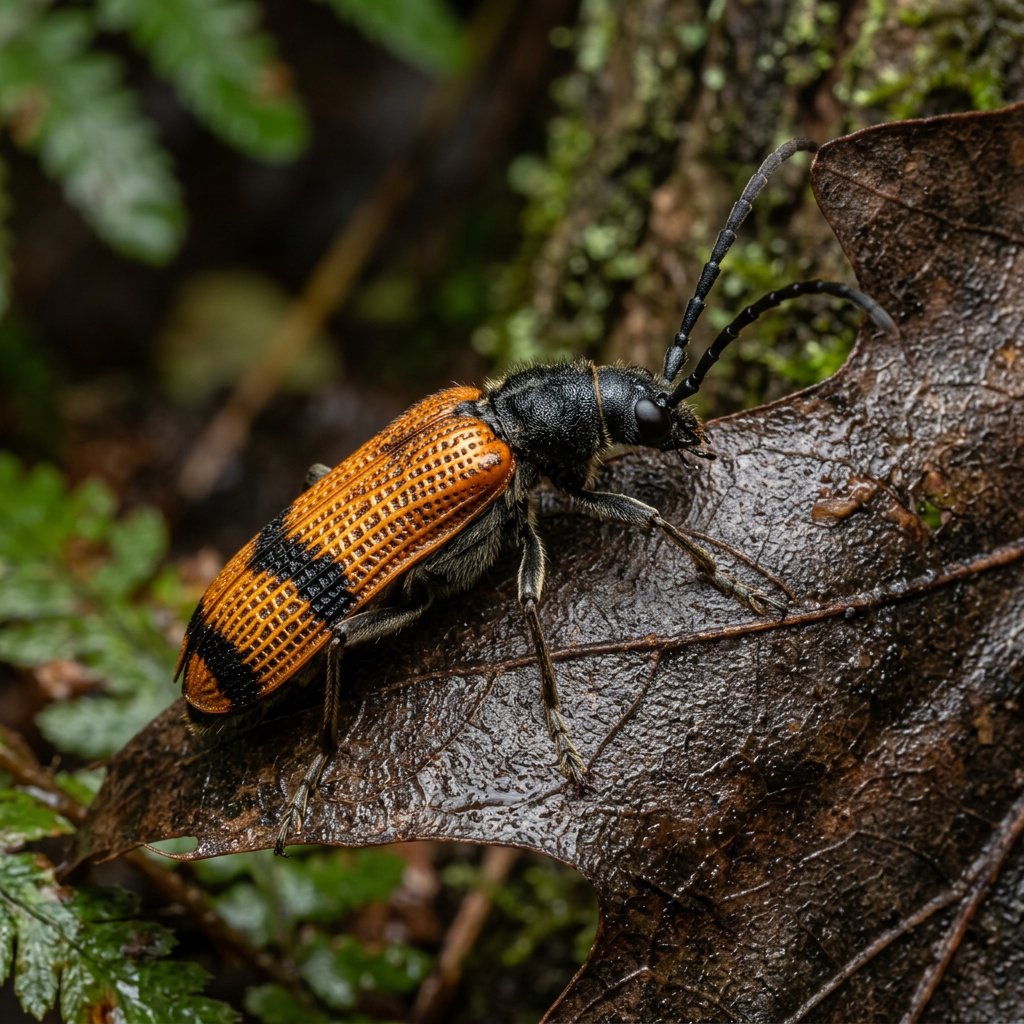
Often called the Banded Net-wing, these beetles look more like intricate pieces of stained glass than your average garden bug. With their striking orange and black patterns, they are the "fashionistas" of the forest floor, signaling to every predator in sight that they are definitely not on the menu. They are slow-moving and graceful, often found resting lazily on foliage in moist, shaded environments.
🔍 How to Identify
- 🕸️ The "Net" Pattern: Their wing covers (elytra) feature a complex network of raised longitudinal ridges and cross-veins, creating a distinct mesh-like texture.
- 🎨 Aposematic Colors: They are dressed in high-contrast bands of bright orange and deep black—a universal nature sign that screams "I taste terrible!"
- 📣 Flared Shape: Unlike the sleek, cylindrical shape of many beetles, Calopteron wings widen significantly toward the back, giving them a flattened, fan-like silhouette.
🌲 Habitat & Ecology
- 🪵 Woodland Wonders: You will most likely spot them in moist, deciduous forests or gardens with plenty of organic mulch. The larvae live in decaying logs or under loose bark, where they act as tiny vacuum cleaners, feeding on slime molds and juices from rotting wood.
- 🌼 Gentle Pollinators: While the larvae are busy in the wood, the adults spend their time on leaves and flowers. They are clumsy flyers and prefer to walk or simply sit still, relying on their "bluff" colors rather than speed to survive.
⚠️ Safety & Toxicity
- 🟢 Safe for Humans: These beetles are completely harmless to gardeners and hikers. They do not bite, sting, or possess any "scary" defensive mandibles.
- 🧪 Chemical Defense: While safe to touch, they are chemically protected. They produce a bitter fluid containing "lycidic acid" to deter predators. If a curious dog or cat tries to eat one, they will likely experience a foul taste and slight nausea, but it is rarely dangerous.
✨ Fun Fact
- 🦋 The Great Pretenders: Because Calopteron beetles are so well-defended by their toxicity, other "tasty" insects—like certain moths and even other beetle species—have evolved to mimic their exact colors and "netted" wing patterns to trick birds into leaving them alone! This is a classic biological trick known as Müllerian mimicry.
More Details








