Info
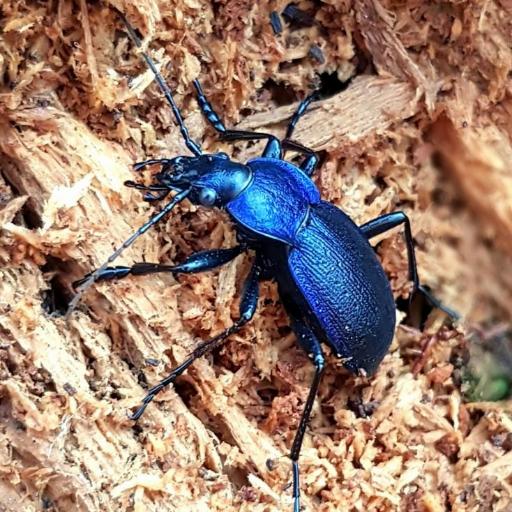
Often called the Ridged Violet Ground Beetle, this nocturnal knight is a prized ally for any gardener. Despite its intimidating "problematic" name—given by scientists who once struggled to classify its many varied forms—it is a tireless hunter that keeps pest populations in check. Its dark, sturdy frame often features a subtle metallic shimmer that makes it look like a piece of living jewelry scuttling across the forest floor.
🔍 How to Identify
- 🪲 Sculpted Shell: The wing cases (elytra) are not smooth; they are covered in rows of fine ridges and chain-like bumps, giving the beetle a rugged, armored appearance.
- ✨ Metallic Trim: While the body is primarily a matte black, the outer edges of the thorax and wing cases often glow with a distinct violet, indigo, or emerald metallic tint.
- 🏃 Built for Speed: It possesses long, powerful legs designed for sprinting across the ground. Unlike many insects, its wing cases are fused shut, meaning it is entirely flightless.
🌲 Habitat & Ecology
- 🐌 The Slug Hunter: This beetle is a voracious predator of garden "villains." It uses its sharp mandibles to feast on slugs, snails, and leatherjackets, making it a biological hero for organic growers.
- 🌙 Night Patroller: It is a strictly nocturnal creature. During the day, it hides in damp, dark micro-habitats like rotting logs, large stones, or thick leaf litter to stay cool and hydrated.
- 🍂 Woodland Resident: While found in gardens, it thrives in heaths and woodlands. It prefers stable environments where the soil isn't frequently disturbed, allowing its larvae to develop safely underground.
⚠️ Safety & Toxicity
- 🛡️ Non-Venomous: The Ridged Violet Ground Beetle is not dangerous to humans or pets. It does not sting and has no venom.
- 🤏 Strong Pinch: If handled roughly, it may use its mandibles to deliver a small, defensive nip. It’s best to observe these beetles without picking them up.
- 🧪 Chemical Defense: When threatened, it can secrete a pungent, foul-smelling liquid from its rear to discourage predators. This isn't harmful, but it is a very effective way to ruin a bird's lunch!
✨ Fun Fact
The species name problematicus was assigned because 18th-century biologists found the beetle so diverse in size and color across different regions that it became a "problem" to figure out if they were looking at one species or dozens of different ones!
More Details








