Info
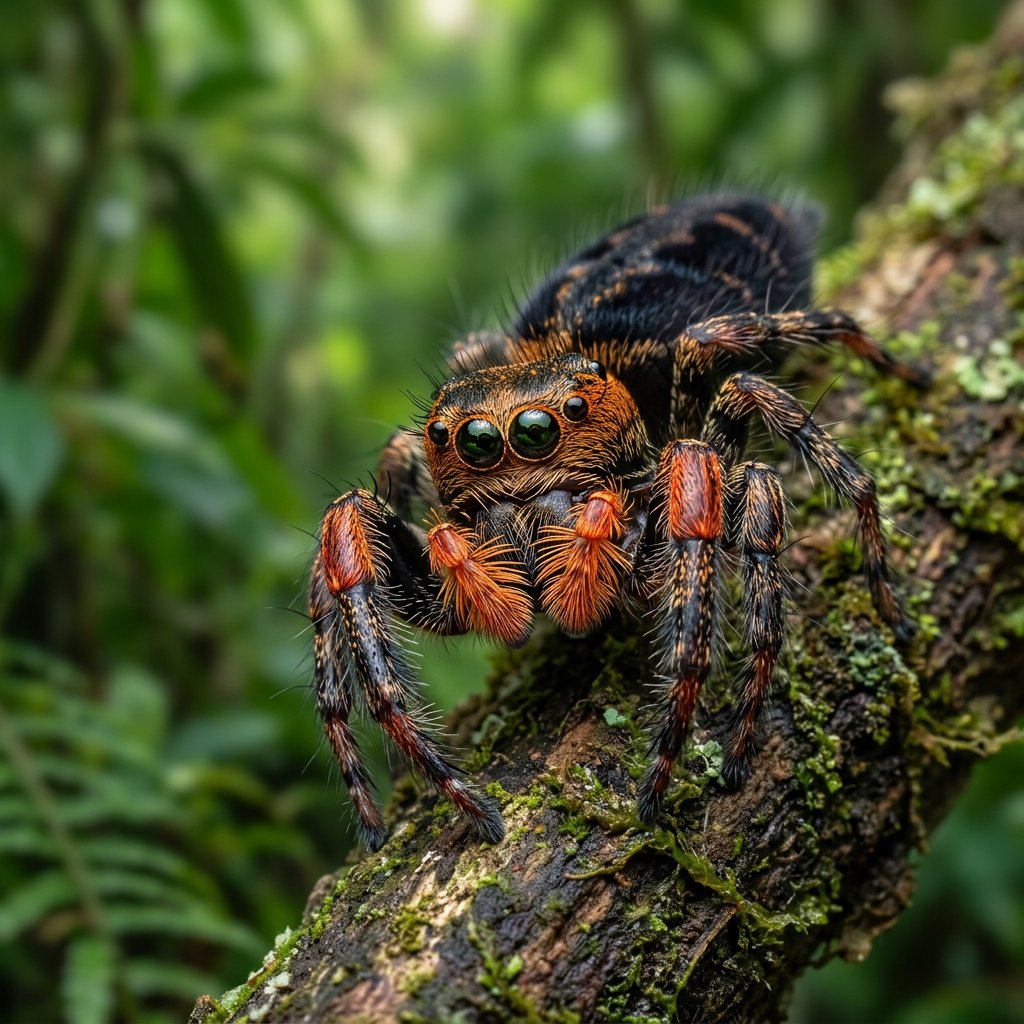
Known as a sophisticated member of the jumping spider family, Carrhotus viduus is often called the "Widow Jumping Spider" due to its dark, mourning-like coloration. These tiny arachnids are the charismatic acrobats of the undergrowth, possessing a level of curiosity and visual intelligence rarely seen in the insect world. While their many eyes might seem intimidating, they are often compared to "eight-legged puppies" because of their expressive movements and tendency to watch humans with genuine interest.
🔍 How to Identify
- 👀 The Headlights: Like all jumping spiders, it features two massive, front-facing primary eyes that give it a "face," flanked by smaller secondary eyes providing nearly 360-degree vision.
- 🕷️ Hirsute Appearance: Their bodies are covered in dense, sensory hairs (setae), often displaying a striking mix of black, white, and subtle orange or brownish-grey patches on the abdomen.
- 👟 Stocky Build: They possess thick, powerful legs—especially the front pair—which are used for pouncing on prey rather than scuttling away like common house spiders.
🌲 Habitat & Ecology
- 🌿 The Sun-Seeker: You will most likely find Carrhotus viduus on the broad leaves of shrubs or garden plants in Southeast Asia and parts of India, where they bask in the sunlight to warm their "jumping muscles."
- 🎯 Active Hunting: Unlike spiders that wait in a web, this species is a precision hunter. It uses its incredible eyesight to track flies and small leafhoppers, tethering itself with a "dragline" of silk before leaping through the air to tackle its meal.
⚠️ Safety & Toxicity
- 🟢 Status: Harmless and non-aggressive.
- 🛡️ Details: While they do possess venom to subduing tiny insects, it is not medically significant to humans or pets. They are incredibly shy and will almost always choose to jump away rather than bite. In the rare event of a "defensive nip," it is typically less painful than a mosquito bite.
✨ Fun Fact
Despite their tiny size, jumping spiders like Carrhotus viduus have better high-definition vision than a domestic cat! They can see in color (including ultraviolet) and are known to solve complex "detouring" problems, meaning they can plan a path to their prey even when it temporarily goes out of sight.
More Details








