Info
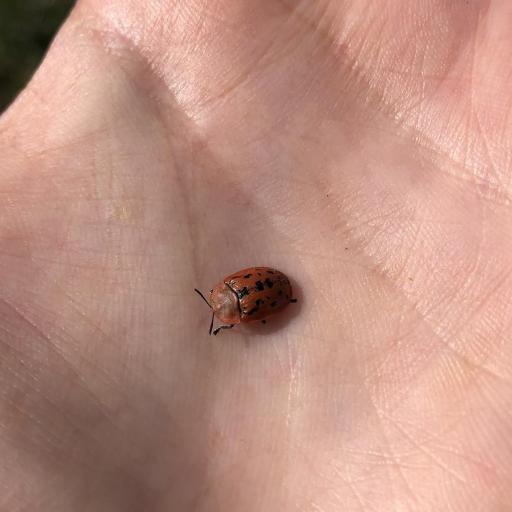
Meet the tiny armored tank of the garden. Often referred to as the Fleabane Tortoise Beetle, Cassida murraea looks like a miniature, iridescent shield crawling across a leaf. With its ability to tuck its head and legs entirely under its shell-like wings, it mimics a drop of water or a small pebble to stay hidden from predators.
🔍 How to Identify
- 🐢 The "Shell": Its body is broad, oval, and extremely flattened. The outer edges of its wing cases (elytra) are translucent and spread out like the brim of a hat, hiding the beetle's legs from view.
- 🎨 Color Palette: While most commonly a vivid, mossy green, some individuals can appear brick-red or brownish. They are typically decorated with small, irregular black spots scattered across their backs.
- 🙈 Hidden Head: From above, you cannot see the beetle’s head or antennae. They are tucked safely under the "pronotum," a wide shield that acts as a protective canopy.
🌲 Habitat & Ecology
- 🍽️ Dietary Preferences: These beetles are strictly vegetarians. You will most likely find them lounging on plants in the Aster family, specifically Fleabane (Pulicaria) and Elecampane (Inula).
- 🛡️ Strategic Larvae: The larvae have a bizarre and effective defense; they construct a "fecal shield" made of their own waste and old skins, which they hold over their backs with a specialized fork to ward off hungry ants and birds.
- 🌿 Meadow Dwellers: They prefer damp meadows, riverbanks, and sunny garden borders where their host plants grow in abundance.
⚠️ Safety & Toxicity
- ✅ Status: Completely harmless.
- 🤏 Gentle Interaction: Cassida murraea does not bite, sting, or carry any toxins. They are safe to observe closely or even gently hold, though they are quite shy and will likely "hunker down" and stay still if they feel threatened.
✨ Fun Fact
Unlike many insects that rely on speed to escape, the Tortoise Beetle uses suction. When a predator tries to flip it over, the beetle can pull its shell tight against the leaf surface, creating a vacuum seal that makes it nearly impossible to pick up!
More Details








