Info
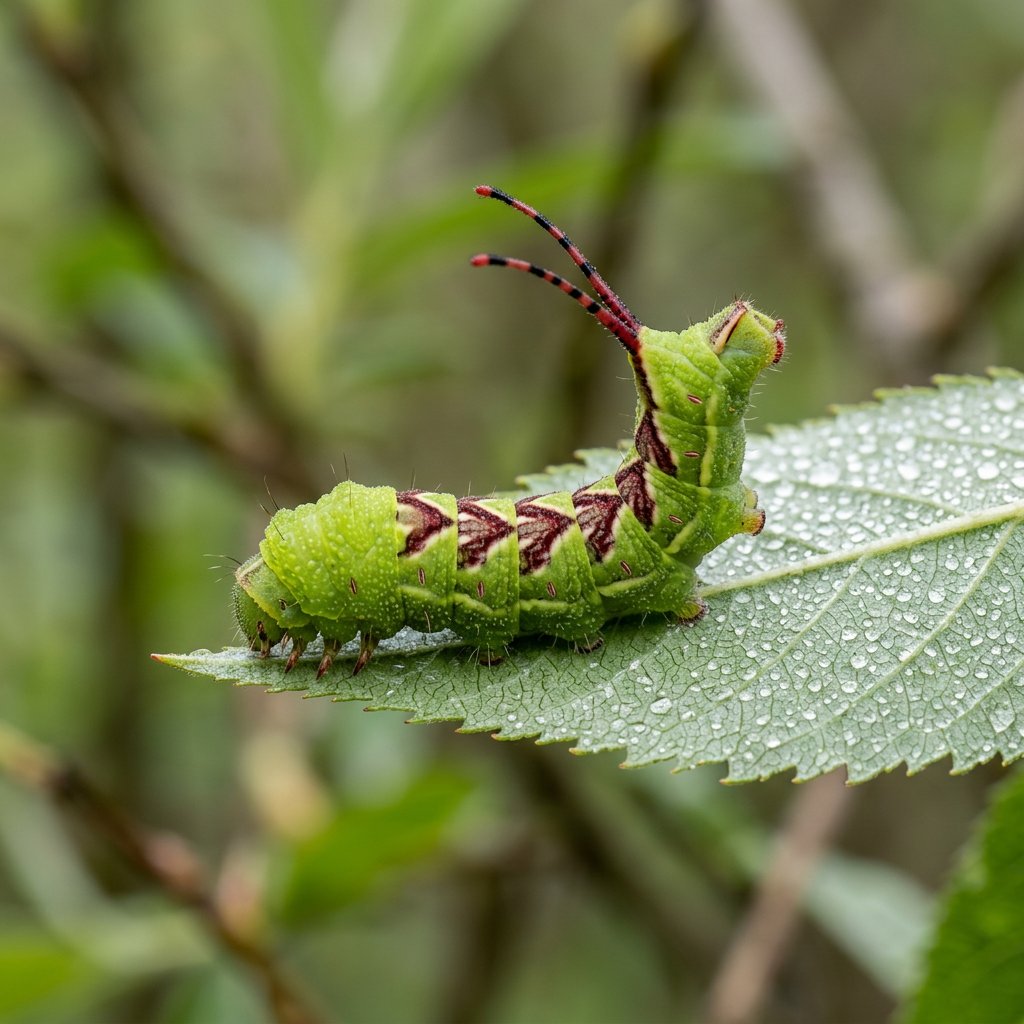
Known affectionately as the Puss Moth, this insect is a master of drama and disguise. While the adult moth looks like a fluffy, cuddly cloud of grey fur, its caterpillar stage is famous for being one of the most "theatrical" larvae in the insect world. Found across Europe and temperate Asia, it is a favorite among nature photographers for its incredible defensive displays.
🔍 How to Identify
- ☁️ The "Kitten" Moth: The adult moth is stout and covered in dense, white-to-light-grey "fur," giving it a soft, feline appearance that inspired its name.
- 🕸️ Marble Wings: Its wings are translucent white, intricately patterned with charcoal-grey zig-zags and delicate veining.
- 🎭 The Neon Warrior: The caterpillar is unmistakable—bright lime green with a dark purple or brown "saddle" on its back and a vivid red ring around its "face."
- 🐍 Tail Whips: The caterpillar features two long, dark, whip-like appendages at its rear, which it can extend to reveal hidden pink "flags" when threatened.
🌳 Habitat & Ecology
- 🍃 Tree Preferences: You’ll most likely find them near Willow, Poplar, or Aspen trees. These are the primary host plants where females lay their chocolate-brown, dome-shaped eggs.
- 🏰 The Wooden Fortress: To survive the winter, the caterpillar constructs a remarkably tough cocoon. It chews up bits of bark and mixes them with silk to create a hard, wood-like shell that is almost impossible to see against the tree trunk.
- 🤺 Aggressive Mimicry: When a predator approaches, the caterpillar rears its head, inflates its red "mask," and lashes its tail whips to look like a much larger, more dangerous creature.
⚠️ Safety & Toxicity
- 🧪 Chemical Defense: While the moth is harmless, the caterpillar is a "spitfire." If its visual display doesn't work, it can accurately spray formic acid from a gland beneath its head.
- 👀 Skin & Eye Warning: This acid can cause sharp stinging and irritation on human skin and is particularly painful if it gets into the eyes of a curious pet or child. It is best to observe this creature without touching it.
✨ Fun Fact
The Puss Moth's cocoon is so incredibly hard that the moth cannot break out with force alone. When it is time to emerge, the moth secretes a special "softening" liquid to dissolve the wall of its fortress, followed by a gentle push to reach the outside world.
More Details








