Info
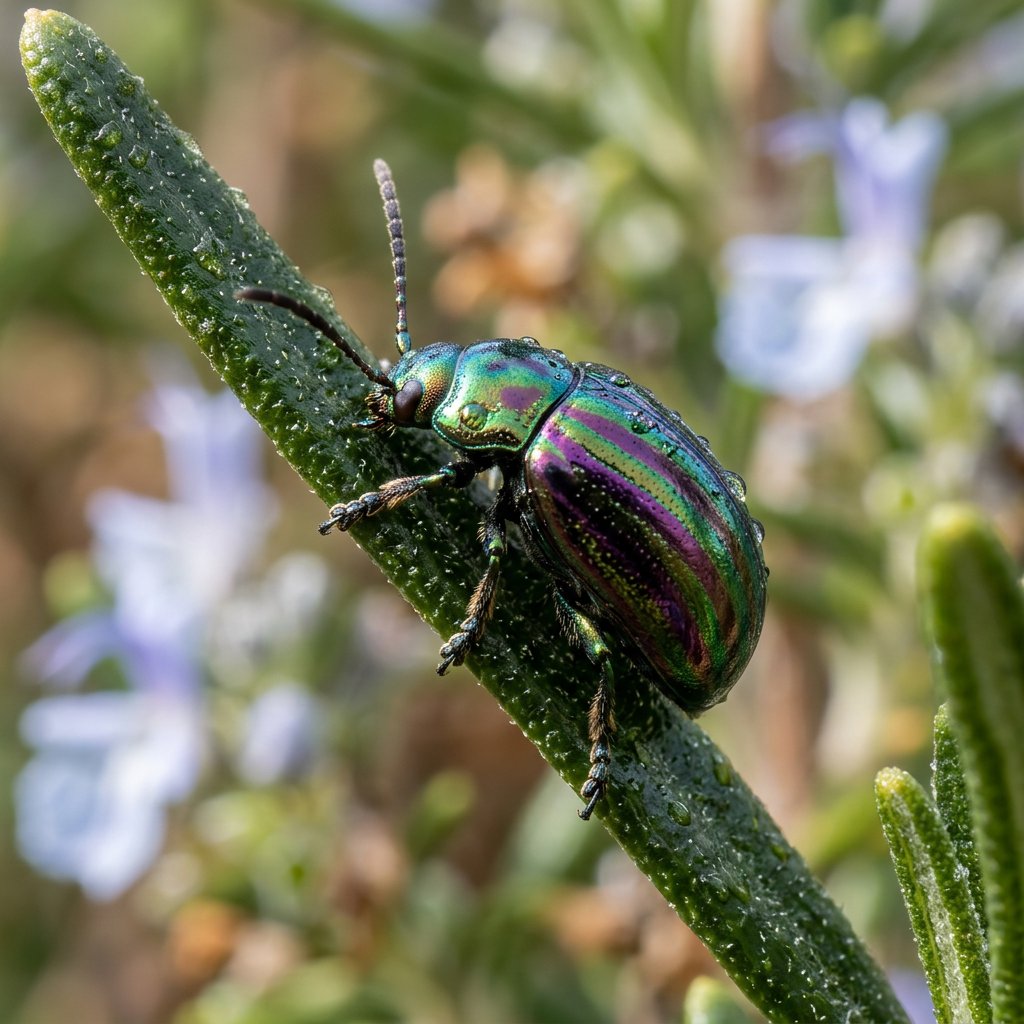
Often referred to as the "Jewel of the Herb Garden," the Rosemary Beetle (Chrysolina americana) is a striking example of nature's artistry. Despite its name, this beetle is not actually from the Americas; it is a Mediterranean native that has slowly expanded its territory across Europe. While it is a "foe" to gardeners who prize their aromatic herbs, its shimmering, metallic appearance makes it one of the most beautiful insects you are likely to encounter among your lavender and sage.
🔍 How to Identify
- 🌈 Metallic Stripes: The most distinct feature is the elytra (wing cases), which boast brilliant, longitudinal stripes of metallic green and deep purple or bronze.
- 🪲 Oval Body: It has a highly convex, rounded shape, typical of leaf beetles, making it look like a tiny, polished gemstone resting on a leaf.
- 📏 Compact Size: These beetles are relatively small, usually measuring between 6mm and 9mm in length—roughly the size of a large pea.
- 🐛 Slug-like Larvae: The young are less glamorous, appearing as greyish-white, fleshy larvae with dark stripes, often found clinging to the undersides of leaves.
🌲 Habitat & Ecology
- 🌿 The Herb Specialist: You will almost exclusively find this beetle on Mediterranean herbs, specifically Rosemary, Lavender, Thyme, Sage, and occasionally Perovskia (Russian Sage).
- 🍽️ Year-Round Resident: Unlike many insects that disappear in winter, adults can be seen on plants throughout the colder months, though they are most active and likely to breed in late summer and autumn.
- 🚶 Slow Movers: They are not known for flying long distances; instead, they slowly crawl through the foliage, grazing on the leaves and flowers of their host plants.
⚠️ Safety & Toxicity
- ✅ Non-Aggressive: The Rosemary Beetle is completely harmless to humans and pets. It does not bite, sting, or carry any diseases.
- 🧪 Chemical Defense: Like many brightly colored beetles, they may secrete a bitter-tasting fluid if handled roughly to discourage birds from eating them, so it is best to observe them without touching.
- 🪴 Garden Impact: While they are beautiful, a large population can "silver" the tips of your herbs by stripping the foliage, though they rarely kill established plants.
✨ Fun Fact
The name Chrysolina americana is actually a historical mistake! When the famous taxonomist Carl Linnaeus first described the species in 1758, he was misled into believing the specimen had come from the Americas. By the time the error was realized, the name had already stuck, leaving this Mediterranean local with a permanent case of mistaken identity.
More Details








