Info
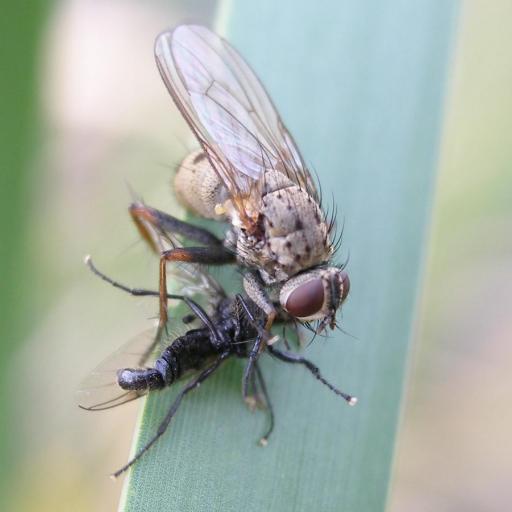
The Coenosia tigrina, commonly known as the Tiger Hunter Fly, is a tiny but fierce predator that acts like a miniature cheetah in your garden. While it belongs to the same family as the common house fly, it has traded scavenging for a life of high-stakes aerial hunting. It is widely considered a "friend" to gardeners and greenhouse owners because of its insatiable appetite for common plant pests.
🔍 How to Identify
- 🦵 Spotted Legs: Its most defining feature is its long, powerful legs covered in dark spots and stiff bristles, which it uses like a cage to trap prey.
- 🩶 Dusty Gray Armor: The body is a sophisticated matte gray or silver, often featuring subtle dark stripes on the thorax that give it its "tiger" namesake.
- 👀 Alert Stance: Unlike a lazy house fly, the Tiger Hunter sits very upright on the tips of leaves, twitching its head to track movement with its large, reddish-brown eyes.
🌲 Habitat & Ecology
- ⚔️ Ambush Predator: This fly is a master of the "sit-and-wait" technique. It perches on high-visibility foliage, launching itself like a surface-to-air missile to grab other insects mid-flight.
- 🪴 Soil-Dwelling Larvae: Before they take to the skies, the larvae live in moist soil or leaf litter. They are equally predatory underground, hunting the larvae of fungus gnats and other soil pests.
- 🎯 Pest Control: They are highly valued in biological pest management because they specifically target "nuisance" insects like leafminers, fruit flies, and aphids.
⚠️ Safety & Toxicity
- ✅ Harmless to Humans: The Tiger Hunter Fly has no interest in human food or skin. They do not bite or sting people and are not known to spread diseases like their filth-dwelling cousins.
- 🐶 Pet Friendly: They are completely non-toxic. If a curious cat or dog happens to snap one out of the air, there is no cause for concern.
✨ Fun Fact
The Tiger Hunter Fly is so efficient that it often kills more prey than it can actually eat! It is known for "sport hunting," where it strikes down a pest and immediately returns to its perch to look for the next target, making it a top-tier guardian for your indoor plants.
More Details








