Info
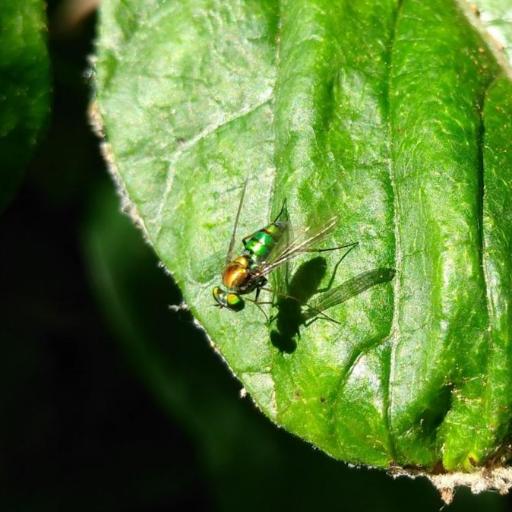
Often called "Long-legged Flies," members of the Condylostylus genus are the shimmering jewels of the insect world. These tiny aerial acrobats are easily recognized by their brilliant, metallic bodies that glint like emeralds or sapphires in the sun. Far from being a pest, they are high-speed predators that act as a natural defense system for your backyard.
🔍 How to Identify
- ✨ Iridescent Armor: A striking metallic exoskeleton that shifts colors between neon green, copper, and blue depending on how the light hits it.
- 🦵 Stilt-like Legs: Extraordinarily long, spindly legs that allow the fly to stand high off the leaf surface, giving it a delicate, "leggy" silhouette.
- 🪽 Wing Carriage: Large, clear wings that are often held out at a 45-degree angle from the body, sometimes featuring subtle dark patterns or smoky bands.
🌲 Habitat & Ecology
- ⚔️ The Garden's Tiny Tiger: These flies are voracious predators of soft-bodied pests. They hunt aphids, thrips, and mites, snatching them up with lightning speed. If you see them on your plants, your garden is likely very healthy.
- 💃 The Sideways Shuffle: They have a very distinct way of moving. Instead of just flying, they perform quick, jerky "runs" across the surface of broad leaves, often darting sideways or in zig-zags to spot their next meal.
⚠️ Safety & Toxicity
- ✅ Harmless Friend: Condylostylus flies are completely harmless to humans and pets. They do not possess a stinger, and their mouthparts are designed for tiny insects, not biting people.
- 🌿 Pesticide Warning: Because they look like "just another fly," they are sometimes accidentally targeted by gardeners. It is best to avoid broad-spectrum sprays to keep these beneficial hunters alive and working for you.
✨ Fun Fact
To win over a mate, the male Condylostylus performs an elaborate "dance" where he waves his front legs and flashes his iridescent body like a tiny, living disco ball to catch the female's attention!
More Details








