Info
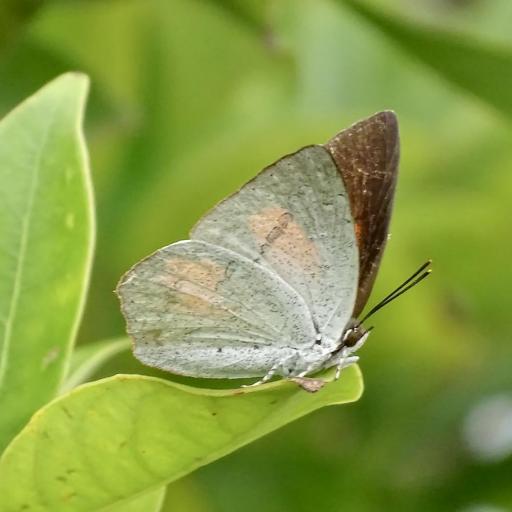
The Angled Sunbeam (Curetis acuta) is a master of visual deception and one of the most striking members of the Lycaenid family. To a casual observer, it looks like a dead leaf or a scrap of silver when resting, but the moment it takes flight, it erupts into a brilliant flash of metallic copper-orange. It is a welcome friend in any garden or forest edge, acting as a delicate pollinator with a truly "electrifying" presence.
🔍 How to Identify
- ✨ Upper Wing Surface: A vibrant, glowing metallic orange with thick black borders, though these are only visible when the butterfly is in motion or basking.
- 🥈 Lower Wing Surface: A stark, satiny silvery-white that lacks any spots or patterns, allowing it to "disappear" against the glare of the sun or bright leaves.
- 📐 Wing Shape: Unlike rounded butterflies, its wings have a distinctively "angled" or hooked apex, which helps mimic the jagged edges of dried foliage.
🌲 Habitat & Ecology
- ☀️ Sun-Seeker: As the name suggests, the Angled Sunbeam thrives in sun-drenched forest openings and shrublands across Asia. You will often find them perched high on leaves, waiting for a "sun-fleck" to hit their wings.
- 🥤 Eclectic Diet: While the adults enjoy nectar, they are also frequently seen "puddling"—drinking from damp sand or even bird droppings to gather essential minerals and salts that they can't get from flowers alone.
- 🛡️ Caterpillar Guards: The larvae have a fascinating relationship with ants. They possess specialized organs that secrete sugary liquids to "bribe" ants into protecting them from predators.
⚠️ Safety & Toxicity
- ✅ Harmless Friend: The Angled Sunbeam is completely safe. It does not bite, sting, or possess any toxins that could harm humans or curious pets.
- 🦋 Fragile Wings: Like most gossamer-winged butterflies, their wings are incredibly delicate. The "dust" on their wings is actually tiny scales; touching them can hinder their ability to fly and regulate temperature.
✨ Fun Fact
The Angled Sunbeam’s caterpillar has a bizarre defense mechanism: if threatened, it shoots out two telescopic "tentacles" from its rear that whirl around like tiny, frantic pom-poms to scare off predatory wasps!
More Details








