Info
Often called the Oleander Hawk-moth or the "Army Green Moth," this insect is a masterpiece of natural camouflage. With a pattern that looks like a hand-painted military fatigue suit, it is widely considered one of the most beautiful moths in the world. Originally from Africa and Asia, it is a famous traveler, often migrating deep into Europe during the warm summer months.
🔍 How to Identify
- 🎨 Camouflage Pattern: Its wings are a swirling mosaic of forest green, olive, cream, and soft pink streaks that help it disappear against leafy backgrounds.
- ✈️ Aerodynamic Shape: Like most hawk-moths, it has a thick, torpedo-shaped body and long, narrow wings built for high-speed, hovering flight.
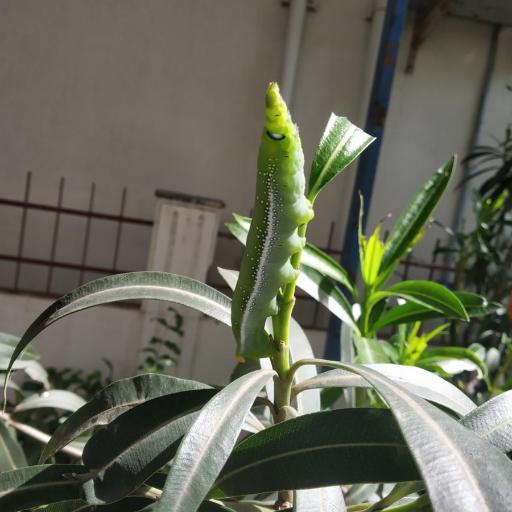
- 👀 The "False Eyes": While the adult is camouflaged, its caterpillar is famous for two large, glowing blue "eyespots" on its head that it uses to mimic a snake and scare off hungry birds.
🌲 Habitat & Ecology
- 🥗 A Specialized Diet: As the name suggests, the larvae feed almost exclusively on the Oleander plant. While Oleander is toxic to most creatures, this insect has evolved to process the toxins without harm.
- 🌙 Twilight Traveler: You are most likely to spot them at dusk (crepuscular). They act much like hummingbirds, hovering mid-air in front of fragrant flowers like Jasmine or Honeysuckle to drink nectar with their long proboscis.
- 🌍 Nature’s Nomad: They are powerful flyers. Driven by the search for fresh host plants, individual moths have been known to fly hundreds of miles during migration.
⚠️ Safety & Toxicity
- 🦋 Status: Completely harmless to humans. They do not bite, and despite their "Hawk" name, they do not have a stinger.
- 🧪 Internal Toxins: While they won't hurt you if they land on your hand, the caterpillars are considered toxic if ingested by pets or curious children. This is because they store the poisonous glycosides from the Oleander leaves they eat as a defense mechanism.
✨ Fun Fact
The Oleander Hawk-moth served as an inspiration for many camouflage patterns used in early 20th-century art and military design. Its ability to break up its silhouette using "disruptive coloration" is so effective that even a resting moth can be nearly impossible to see on a simple green leaf.
More Details








