Info
Often found in a dramatic group huddle, the Yellow-necked Caterpillar is a master of synchronized defense. While they might look like a swarm of tiny, striped snakes when they lift their heads and tails simultaneously, these "social" caterpillars are far more interested in your oak trees than in bothering you.
🔍 How to Identify
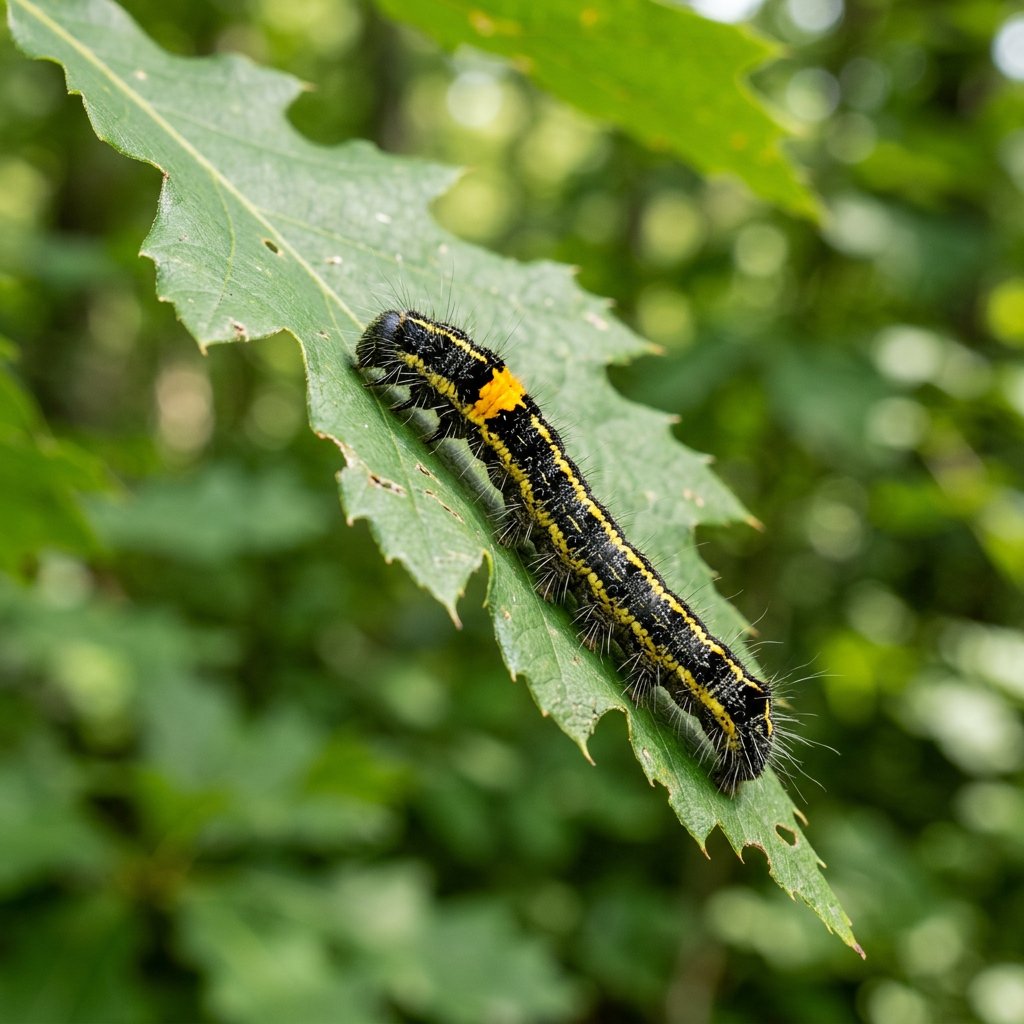
- 🟡 The "Yellow Neck": The most distinguishing feature is a bright yellow or orange-yellow band (the prothoracic shield) located directly behind the glossy black head.
- 🦓 Body Patterning: Their long bodies are jet black and marked with several longitudinal yellow or creamy-white stripes that run from head to tail.
- 🕸️ Fine Hairs: While they aren't "furry" like some other species, they are sparsely covered in long, thin, white hairs that give them a slightly fuzzy silhouette.
🌲 Habitat & Ecology
- 🌳 Hardwood Favorites: These insects are common residents of deciduous forests and suburban backyards, favoring the leaves of oak, walnut, birch, and fruit trees like apple or cherry.
- 🤝 Strength in Numbers: They are highly gregarious, meaning they live and feed in large clusters. You will often find dozens of them stripping a single branch down to the midrib before moving to the next one as a group.
- 🦋 The Adult Phase: After pupating in the soil, they emerge as the Yellow-necked Caterpillar Moth, a cinnamon-brown moth with dark, wavy lines across its wings that blend perfectly with dried leaves.
⚠️ Safety & Toxicity
- 🛡️ The Defensive "U": When they feel threatened by a bird or a curious human, the entire group will simultaneously arch their heads and tails into the air to form a "U" shape. This is a bluff meant to look intimidating.
- ✅ Non-Toxic: Unlike some "hairy" caterpillars, this species does not possess stinging hairs (urticating hairs) or venom. They are physically harmless to humans and pets, though they may regurgitate a dark green fluid if handled roughly.
- 🍂 Tree Health: While they can defoliate individual branches, they rarely kill healthy, mature trees. For young saplings, however, a large colony can be stressful.
✨ Fun Fact
When one caterpillar in the group senses a vibration or a predator, it triggers a chain reaction—the entire colony will perform their "U-shaped" defensive pose at the exact same time, a behavior known as "synchronous signaling" designed to confuse and startle hungry birds!
More Details








