Info
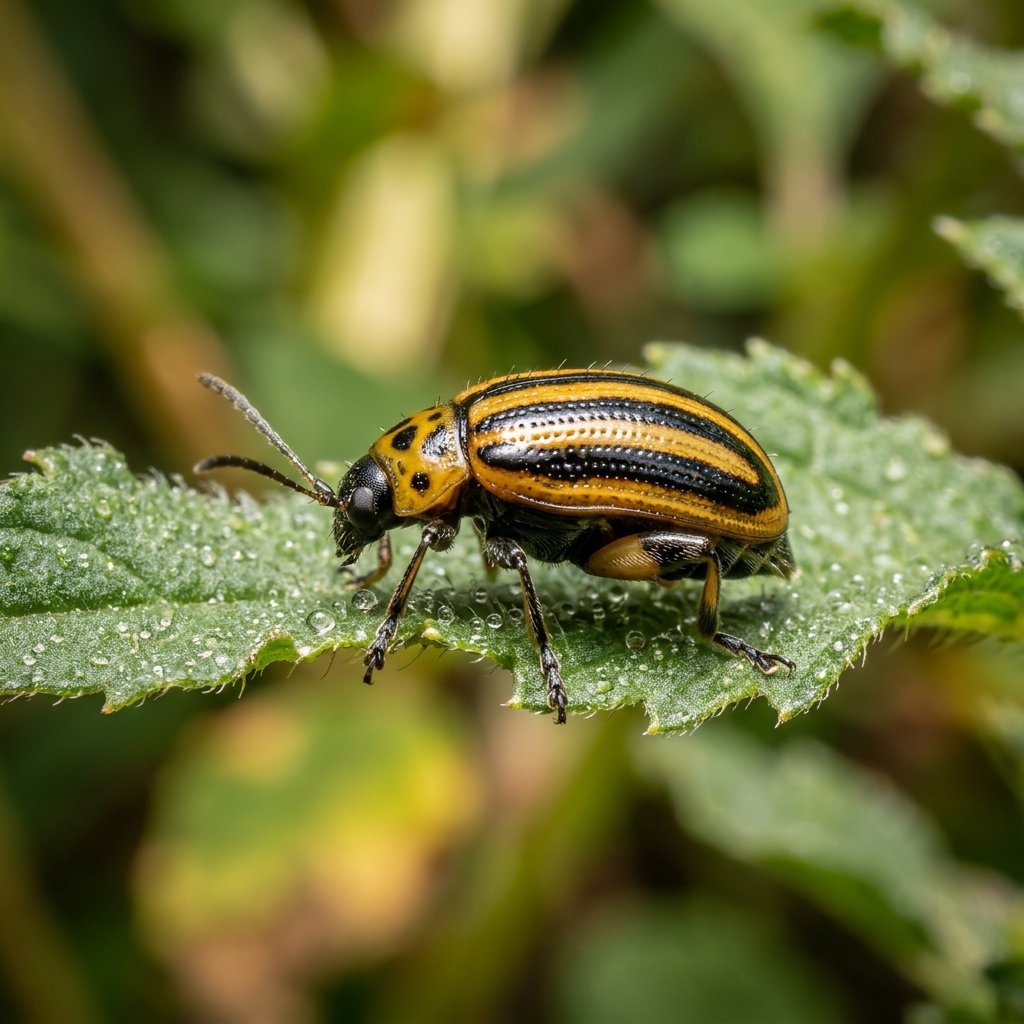
Often called the Pigweed Flea Beetle, Disonycha glabrata is a tiny, flashy insect that looks like it’s wearing a miniature yellow-and-black racing suit. While its bold stripes might make it look like a tiny bee from afar, it is actually a highly specialized leaf beetle. It is a common sight in gardens and fields where its favorite snack—the Amaranth plant—grows in abundance.
🔍 How to Identify
- 🪲 Bold Stripes: The most striking feature is its wing covers (elytra), which feature three distinct black longitudinal stripes set against a creamy white or pale yellow background.
- 🎨 Contrast Coloring: Unlike other similar beetles, it usually sports a bright reddish-orange "shield" (thorax) and head, providing a sharp contrast to the striped body.
- 🦵 Spring-Loaded Legs: It possesses notably thickened hind thighs. These are "flea-like" legs designed for explosive jumping rather than just walking.
🌲 Habitat & Ecology
- 🍃 The Amaranth Specialist: This beetle is a picky eater. It focuses almost exclusively on "Pigweed" (Amaranthus species). While gardeners growing ornamental Amaranth might find them a nuisance, they are often seen as "nature’s weed control" in agricultural fields.
- 🦘 The Escape Artist: Their name "Flea Beetle" comes from their primary defense. When they sense the vibration of a footstep or a reaching hand, they use their powerful hind legs to snap-jump several feet away, appearing to vanish instantly.
- 🐛 Double-Threat Life: Both the adults and the dark, soft-bodied larvae feed on the same plants. While the adults chew holes in the leaves, the larvae often congregate to "skeletonize" the foliage, leaving only the veins behind.
⚠️ Safety & Toxicity
- 🛡️ Safe for Humans: The Pigweed Flea Beetle is completely harmless to humans and pets. They do not bite, sting, or carry any venom.
- 🌱 Vegetation Risk: While they pose no physical threat to you, they can be devastating to spinach, beets, and Swiss chard, which are closely related to their favorite pigweed. If you keep an edible garden, you may want to move them along!
✨ Fun Fact
The "spring" in their jump is powered by a tiny, high-tension internal structure in their legs called a metafemoral spring. This mechanism allows them to accelerate at a rate that would be physically impossible through muscle power alone, effectively turning their legs into biological catapults!
More Details








