Info
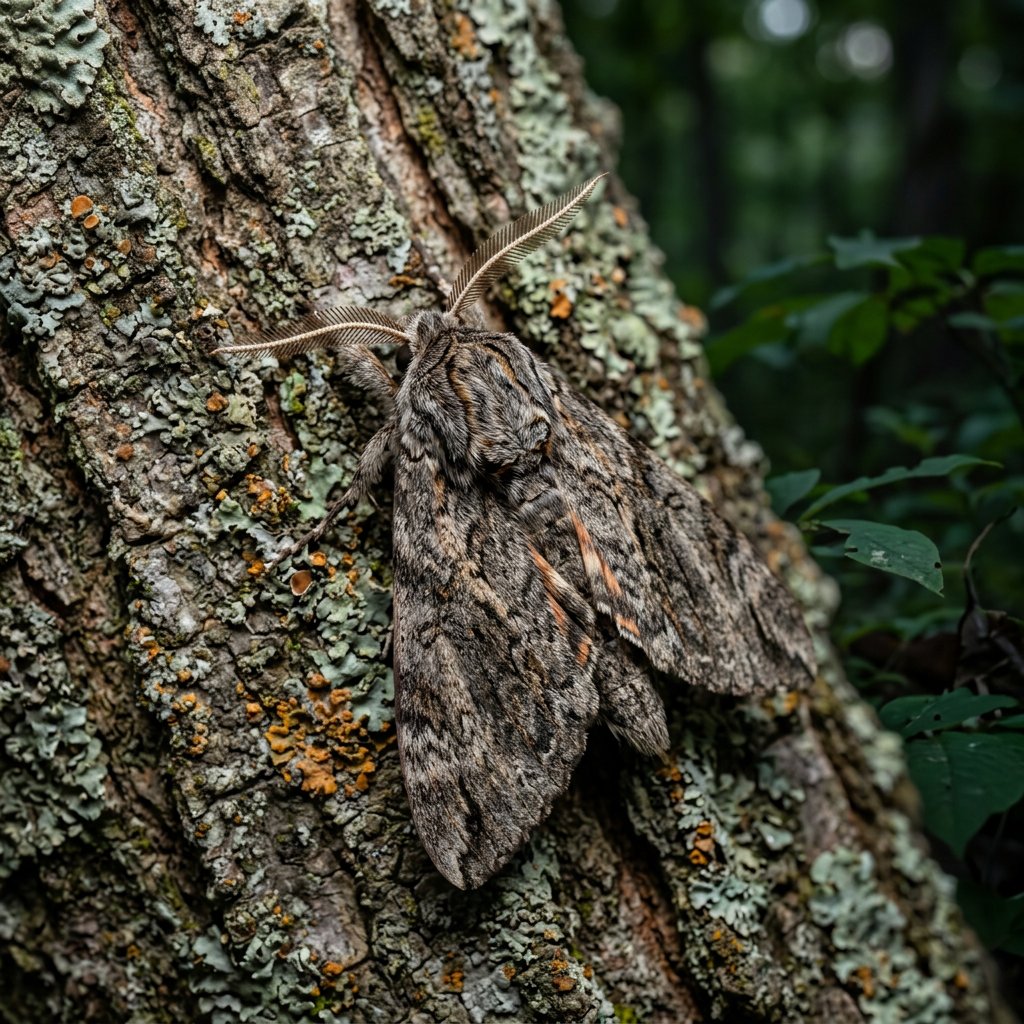
Often called the Pawpaw Sphinx, this master of disguise is a ghost of the eastern North American forests. Unlike its larger, more famous cousins, this moth stays relatively small and blends perfectly with tree bark to avoid birds during the day. It is a frequent visitor to native gardens, where it darts between flowers at dusk like a tiny, shadowy hummingbird.
🔍 How to Identify
- 🦋 Cryptic Wings: The forewings are a complex mosaic of dark brown, black, and white streaks. When resting on a trunk, the pattern breaks up its silhouette, making it nearly invisible.
- 🚀 Aerodynamic Shape: It possesses the classic "Sphinx" look—a thick, muscular, fuzzy body with narrow, pointed wings built for high-speed, precision flight.
- 🐛 The Larva: As a caterpillar, it is a bright lime-green "hornworm" featuring seven pairs of diagonal white stripes and a distinctive small "horn" on its rear end.
🌲 Habitat & Ecology
- 🌳 The Pawpaw Connection: While it enjoys blueberries and hollies, its primary nursery is the Pawpaw tree (Asimina triloba). It plays a crucial role in the lifecycle of these unique native fruit trees.
- 🌙 Nighttime Specialist: This moth is a vital nocturnal pollinator. It uses an incredibly long proboscis (tongue) to sip nectar from deep-throated flowers that are often inaccessible to bees and butterflies during the day.
⚠️ Safety & Toxicity
- ✅ Harmless: The Pawpaw Sphinx is a "gentle giant" of the insect world. It does not bite, sting, or possess any venom.
- 🐶 Pet & Human Safe: Neither the moth nor its caterpillar are toxic to touch. Even if a curious dog or cat happens to find one, they are not considered a poisonous threat, though the "horn" on the caterpillar might give a tiny, harmless poke.
✨ Fun Fact
Sphinx moths like Dolba hyloeus are among the fastest-flying insects in the world; some of its relatives have been clocked at speeds of over 30 miles per hour!
More Details








