Info
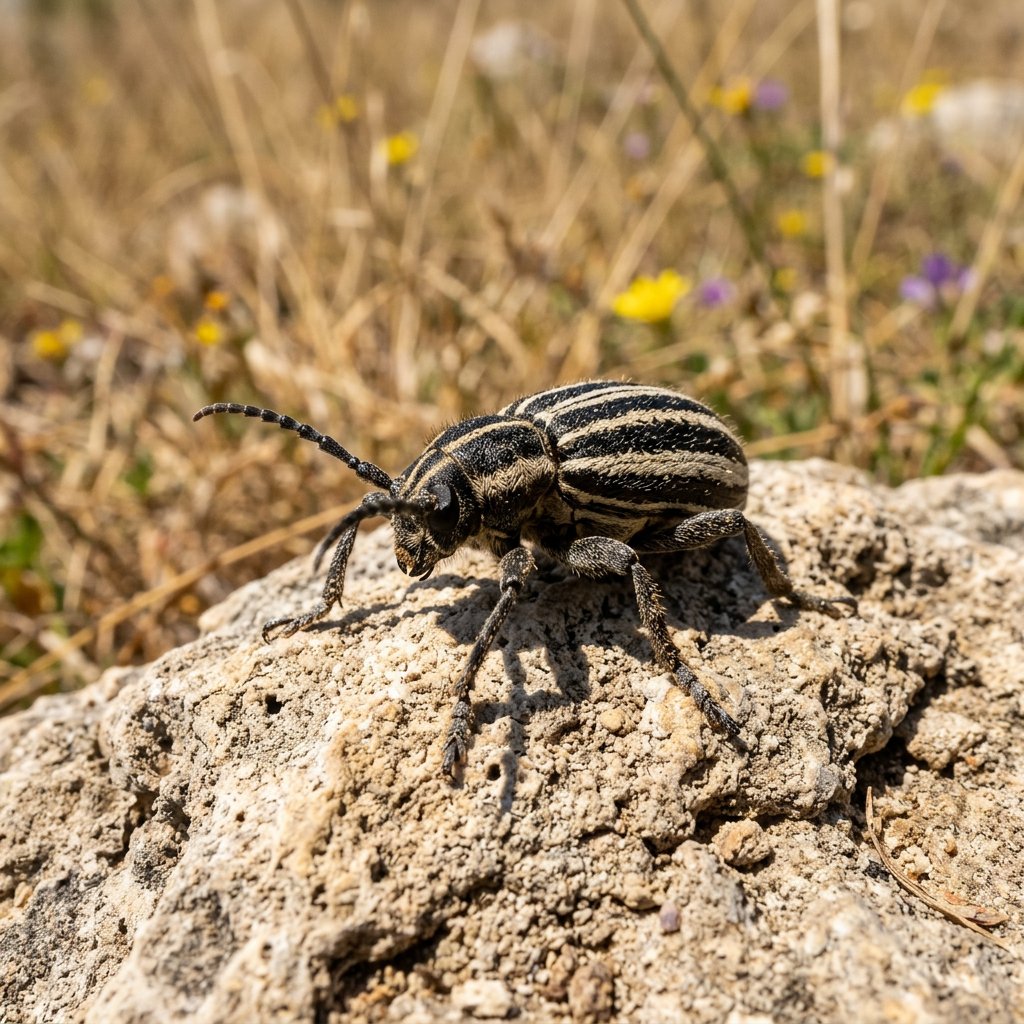
Meet the "Earthbound Knight" of the beetle world. Unlike their cousins who take to the skies at the first sign of trouble, the Dorcadion genus—often called Pedestrian Beetles—has completely traded flight for a life on foot. These sturdy, velvet-textured wanderers are a common sight in the grasslands and steppes of Europe and Asia, where they can be seen marching purposefully across sunny paths in search of a mate.
🔍 How to Identify
- 🛡️ The Fused Shield: Their wing covers (elytra) are fused together into a solid, protective dome. Because they cannot fly, they lack the delicate hind wings found in most other beetles.
- 🧵 Velvet Suit: Most species are covered in extremely fine, dense hairs that give them a matte, velvety appearance, often in earthy tones of charcoal, chocolate, or tan with striking white racing stripes.
- 📏 Thick Antennae: True to their "Longhorn" family lineage, they possess thick, segmented antennae that curve gracefully backward, used to "smell" their way through the grass.
🌲 Habitat & Ecology
- 🌾 Grassland Specialists: You won’t find these beetles in deep forests; they are lovers of the open sun. They thrive in dry meadows, alpine pastures, and even suburban gardens that border wild grasslands.
- 🌱 Root-Bound Life: While the adults enjoy nibbling on fresh blades of grass and stems, their larvae spend their lives hidden underground, where they feed on the roots of various grasses.
- 🚶 Slow Migrators: Because they are flightless, Dorcadion populations move very slowly over generations. This has led to "speciation," where a single mountain valley might have a unique species found nowhere else on Earth.
⚠️ Safety & Toxicity
- 🛡️ Non-Aggressive: These beetles are completely harmless to humans. They have no stinger and no chemical spray; their only defense is their hard shell and their ability to play dead.
- 🤏 Gentle Handling: If you pick one up, it might attempt a tiny pinch with its mandibles, but it is rarely strong enough to break human skin. They are safe to observe closely with children and pets.
✨ Fun Fact
Because Dorcadion beetles cannot fly, they are considered "living fossils" of their specific landscapes. Scientists often use them to study how ancient mountain ranges and rivers formed, as the beetles' inability to cross natural barriers trapped them in "evolutionary pockets" for millions of years!
More Details








