Info
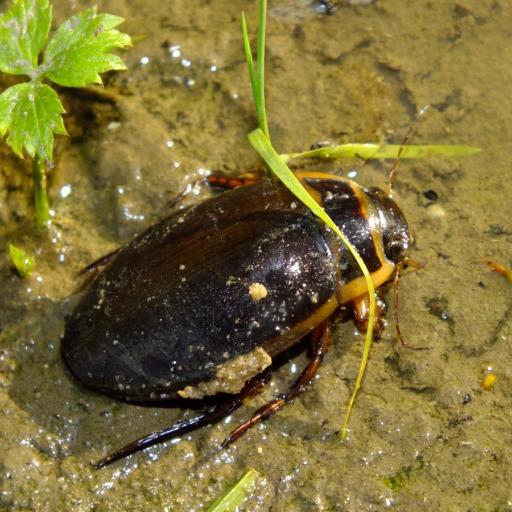
Often called the Great Diving Beetle, this insect is the undisputed king of the garden pond. With its sleek, armored body and golden-yellow edges, it looks like a miniature submarine patrolling the depths. Don't let its graceful swimming fool you; it is a legendary predator known to local amphibians and smaller insects as the "water tiger."
🔍 How to Identify
- 🪲 Golden Border: Its name (marginalis) comes from the distinct yellow-to-orange margin that runs around the edge of its dark, olive-green or black shield-like wing covers.
- 🛶 Oar-like Legs: Its hind legs are flattened and fringed with stiff hairs, acting like powerful paddles for high-speed underwater propulsion.
- 📐 Smooth vs. Grooved: Males have smooth wing covers, while females often have deep longitudinal grooves, a physical adaptation that helps the male maintain a grip during mating.
🌲 Habitat & Ecology
- 💧 The Scuba Diver: To breathe, the beetle hangs upside down at the water's surface to trap an air bubble under its wings. This acts as a portable "scuba tank," allowing it to stay submerged for long periods.
- 🍽️ Fierce Predator: Both the larvae and adults are voracious carnivores. They hunt anything they can catch, including tadpoles, small fish, and other water insects, using their sharp mandibles to deliver digestive enzymes that liquefy their prey.
- ✈️ Night Flyer: If its pond dries up or food becomes scarce, it waits for a moonlit night to climb out and fly to a new home. They are often attracted to artificial lights or shiny surfaces like car roofs, which they mistake for water.
⚠️ Safety & Toxicity
- 🦷 The Pinch: While not venomous or aggressive toward humans, they have very strong mandibles. If you pick one up, it may deliver a sharp, painful bite in self-defense.
- 🛡️ Chemical Defense: When threatened, they can emit a foul-smelling, milky fluid from glands behind their head. This secretion is meant to taste terrible to birds and larger fish, but it can also irritate human skin or eyes.
✨ Fun Fact
Male Great Diving Beetles have specialized "suction cups" on their front legs. These microscopic structures are used to firmly grip the slippery, grooved back of the female during underwater mating maneuvers so they don't get swept away!
More Details








