Info
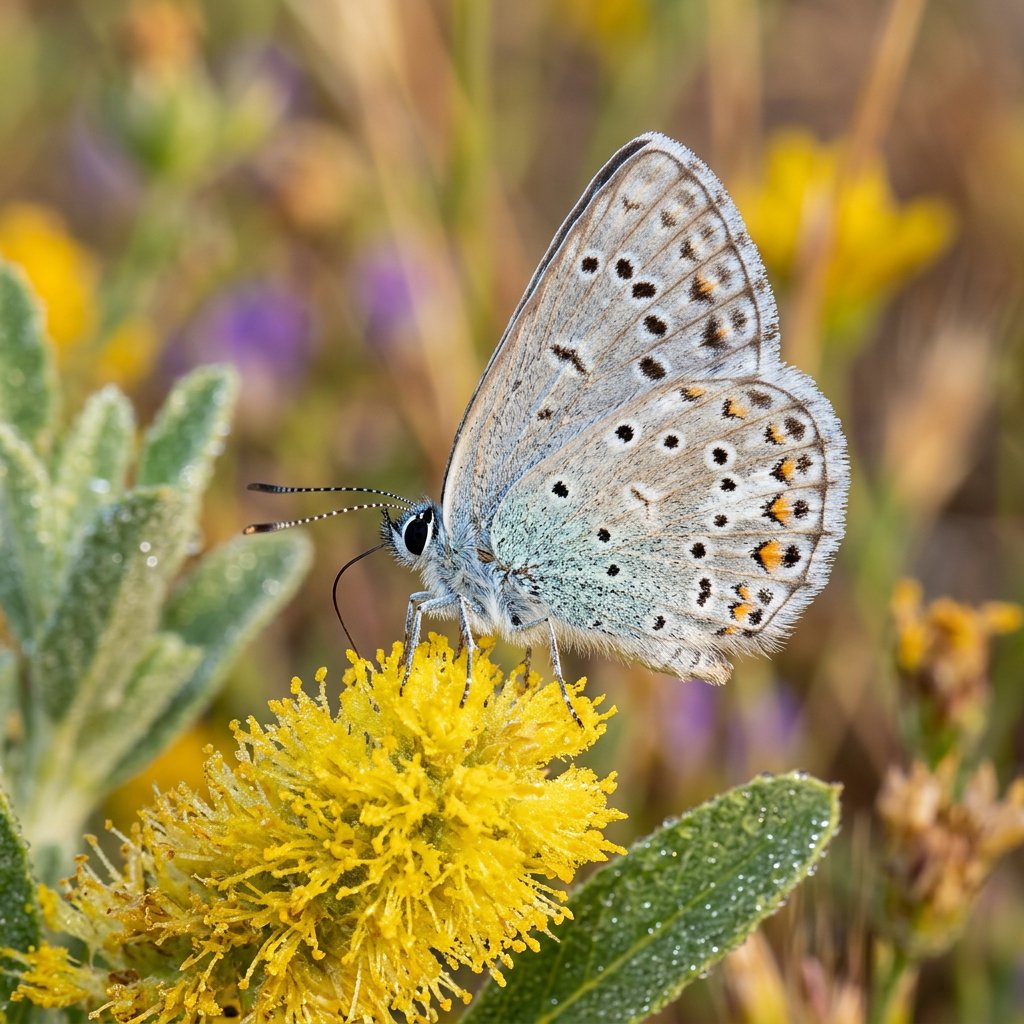
Often called the Reakirt's Blue, this dainty butterfly is a master traveler of the sunny plains and backyard gardens. While it is small enough to be overlooked, its intricate wing patterns tell the story of a resilient wanderer that migrates north every summer. It is a gentle, welcome visitor that brings life to low-growing wildflowers and clover patches.
🔍 How to Identify
- 🦋 The Upper Wing: Males display a soft, lilac-blue shimmer with thin black borders, while females are primarily a dusky charcoal-brown with a light dusting of blue near the body.
- ⚪ The Row of Spots: On the underside of the forewing, look for a very straight, rhythmic row of five or six prominent, white-ringed black spots that look like a string of pearls.
- 👁️ The Hindwing "Eyes": The underside of the hindwing features two distinct, small black spots near the outer edge, which serve as "false eyes" to trick birds into attacking the wings instead of the butterfly's head.
🌲 Habitat & Ecology
- 🌾 Legume Specialist: These butterflies are evolutionary partners with the pea family. You’ll often find them fluttering low to the ground near Alfalfa, Clover, and Indigo, where the females lay their tiny, sea-foam green eggs.
- 🗺️ The Great Wanderer: Unlike some butterflies that stay in one territory, Reakirt's Blue is a famous "colonizer." They spend their winters in the warm south (Mexico and the Southwest US) and push steadily north as far as Canada as the season warms.
- 🌼 Feeding Habits: Adults have a short proboscis, meaning they prefer "flat" flowers like Shepherd’s Purse or Spearmint where the nectar is easy to reach.
⚠️ Safety & Toxicity
- ✅ Completely Harmless: Reakirt’s Blue does not bite, sting, or possess any chemical toxins. They are perfectly safe to observe closely and are a delight for children to watch.
- 🛡️ Ecological Indicator: Their presence is a great sign that your garden is a healthy, pesticide-free environment. They are sensitive to heavy chemical sprays.
✨ Fun Fact
The "isola" in its scientific name Echinargus isola is Latin for "isolated" or "solitary." This refers to the way its wing spots are uniquely separated and distinct compared to its cousins in the "Blue" butterfly family!
More Details








