Info
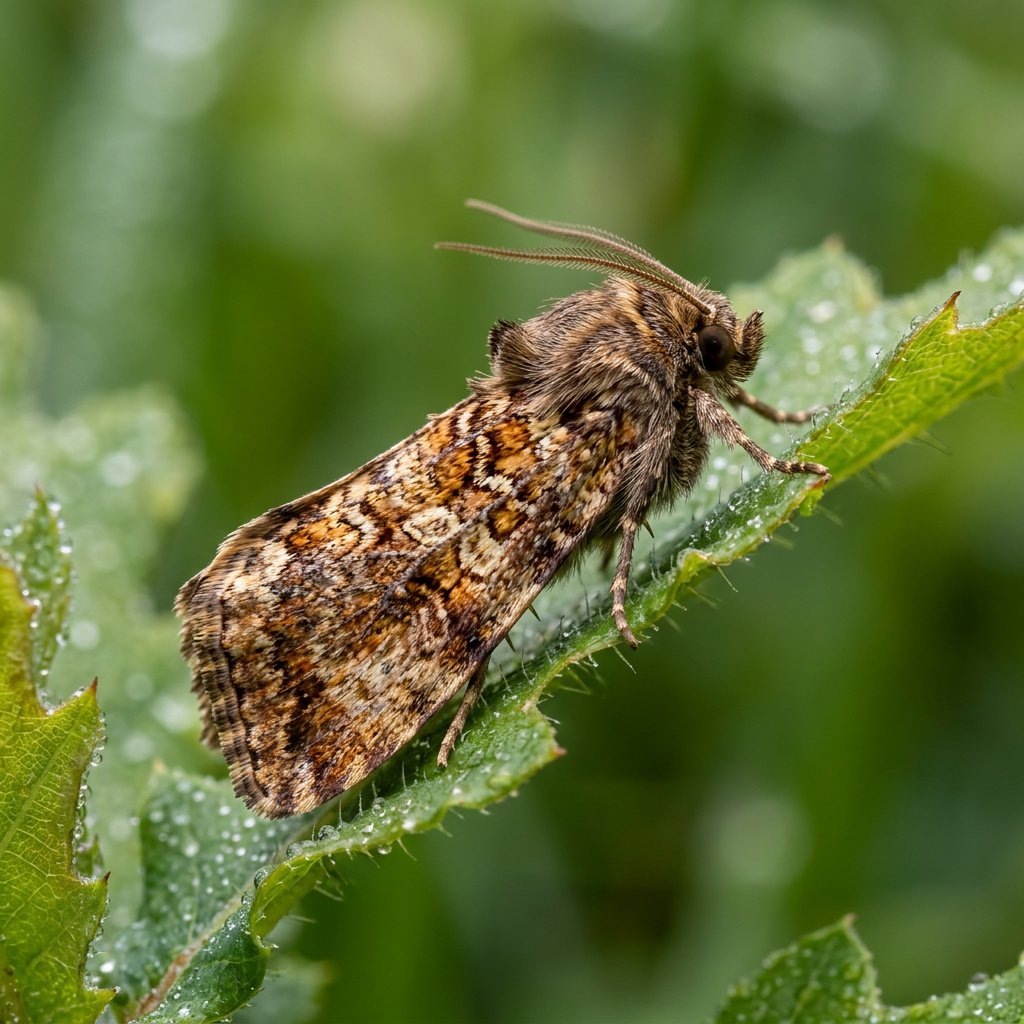
Often referred to as the Grotian's Tortrix, this miniature marvel is a member of the "leaf-roller" moth family. Named after the 18th-century naturalist August Grotian, this moth looks like a tiny, intricate tapestry woven from threads of gold and mahogany. It is a common but often overlooked resident of ancient woodlands and overgrown gardens, spending its days camouflaged against bark and its nights dancing around lanterns.
🔍 How to Identify
- 🎨 The Patterns: The forewings feature a beautiful mottled pattern of yellowish-ochre, marked by a bold, dark-brown diagonal band (fascia) and a distinctive dark spot near the wing tip.
- 🔔 The Silhouette: When resting, it holds its wings in a flat, bell-shaped or "shield" profile, which is a classic characteristic of the Tortricidae family.
- 📏 The Scale: It is quite petite, with a wingspan usually ranging between 13mm and 17mm—roughly the width of a standard shirt button.
🌲 Habitat & Ecology
- 🍂 Dietary Habits: As caterpillars, they are generalist feeders, munching on the foliage of deciduous trees and shrubs like Oak (Quercus), Hawthorn (Crataegus), and even Bramble.
- 🏠 The Leaf-Roller Life: True to their family name, the larvae use silk to roll or tie leaves together, creating a private, silk-lined "apartment" where they can feed safely away from the prying eyes of birds.
- 🌙 Nocturnal Activity: The adults are most active from dusk through the night during the summer months (June to August) and are frequently drawn to garden light traps or porch lights.
⚠️ Safety & Toxicity
- ✅ Harmless Guest: The Grotian's Tortrix is completely harmless to humans and pets. It does not bite, sting, or carry any known diseases.
- 🌿 Garden Impact: While the larvae eat leaves, they rarely appear in numbers large enough to cause significant damage to garden plants or trees. They are a natural part of the ecosystem, providing a vital food source for nesting birds.
✨ Fun Fact
The intricate "scribbled" patterns on their wings are a form of disruptive coloration; when the moth sits still on a lichen-covered branch, the dark bands break up its outline, making it virtually invisible to predators!
More Details








